13th January 2025
Publication Information
Download Publication
- 642 KB PDF
- 13th January 2025
Stay Informed
Get email updates about new ACCR research and shareholder advocacy on specific topics of interest to you.
Sign UpIn November, Shell gave an update on its emerging markets lobbying, following a commitment earlier in 2024 to provide additional disclosures on its lobbying in “5-10 emerging and developing markets that are significant for our strategy, before our 2025 AGM”.[1] This commitment was given in response to investor pressure, including a shareholder resolution filed by institutional investors and ACCR.
Greater transparency of Shell’s climate and energy lobbying in emerging markets is crucial for investors. Our research, published last March, revealed investors have been flying blind, with Shell’s disclosures providing no substantial insight into its lobbying activities in emerging markets.
The new information includes previously undisclosed industry associations and new advocacy updates. Still to come is expanded coverage in Shell’s Climate and Energy Transition Lobbying Report in 2025. The updated disclosures still largely omit gas lobbying in markets which Shell’s bullish LNG growth strategy is targeting. This information is important because with over one billion tonnes of uncontracted LNG in its portfolio out to 2050, Shell has an incentive to lobby for increased LNG use in these markets. Shell needs to demonstrate to investors that its lobbying in key emerging markets does not slow the energy transition and is aligned with its decarbonisation commitments.
ACCR and institutional investors raised these concerns with Shell in December. This prompted small, additional changes in the company’s disclosures: the addition of ‘LNG’ to the name of its ‘gas and low-carbon gases’ advocacy category; and a note that the countries it has selected for disclosure “include our top 10 countries by expected cash flow from operations.”
A step-change in Shell’s approach to lobbying disclosures is still needed to ensure adequate insight into its material lobbying activities and to show investors it is lobbying in line with the Paris goals. Ahead of Shell’s Q1 advocacy updates, ACCR and investors will seek to meet with the company again to request these enhancements.
Ahead of its 2025 AGM, Shell has the opportunity to address these shortcomings by enhancing its approach in its association list, advocacy updates, and upcoming Climate and Energy Transition Lobbying Report.
Investors can consider the following in their engagements with Shell on its climate and energy policy lobbying:
Methodology and proportionality of disclosures
Specificity of disclosures
Alignment with strategy and decarbonisation
Shell has added the following information about emerging markets lobbying to its disclosures:
Shell’s additions to its advocacy updates provide new information on its lobbying in emerging markets. These updates are on policy engagement areas that correspond to Shell’s overarching policy positions, though proportionally more information is provided on CCS, carbon pricing, methane, and net-zero implementation.
These additions do not rebalance Shell’s disclosures to make them proportionate to its large fossil fuel growth ambitions and lobbying footprint in emerging markets.
Omission of markets targeted for LNG demand growth. Shell’s emerging markets disclosures focus more on countries where it has large fossil fuel production.
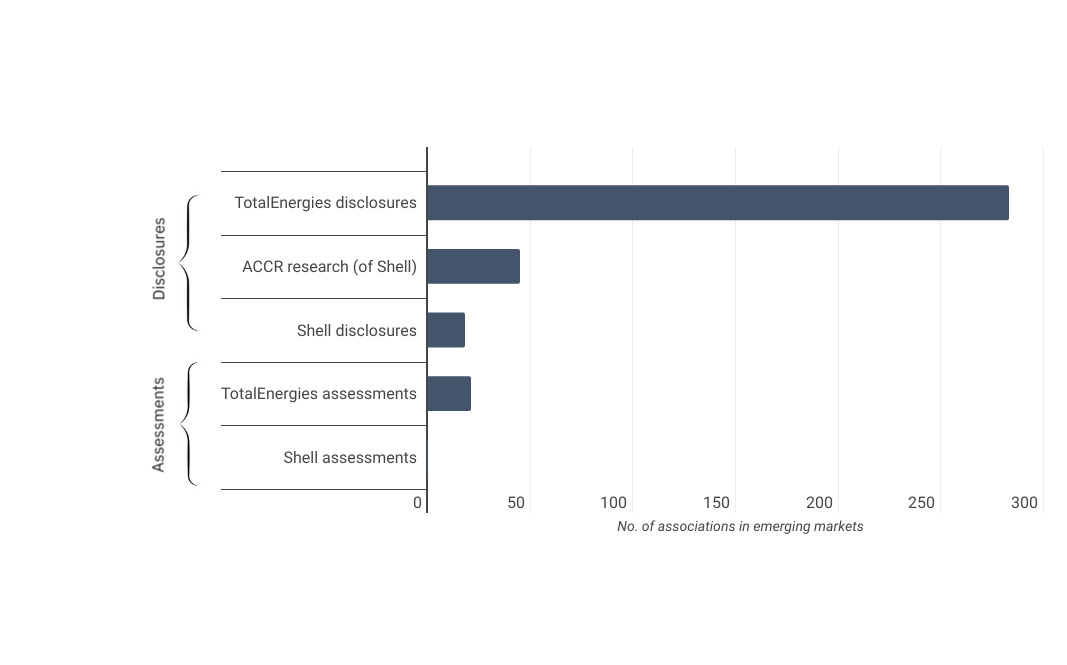
Few associations disclosed in emerging markets. Only a small proportion of the associations Shell discloses are based in emerging markets. Its list of industry associations contains six (<5%) and its advocacy updates mention another 12. This is despite a large proportion of Shell’s future production and sales being in emerging markets. TotalEnergies discloses and assesses significantly more associations in emerging markets in both absolute and percentage terms,[6] while ACCR’s previous research found at least 45 notable Shell associations which engaged in climate and energy policy advocacy in emerging markets.
Figure: Shell reports far fewer associations in emerging markets than TotalEnergies and ACCR’s research of Shell
The methodology Shell uses for selecting countries and associations to report on is not transparent, and fails to properly capture material lobbying, especially in emerging markets.
Opaque method for selecting countries does not properly capture material lobbying. Shell is not transparent about how it selects countries for its lobbying disclosures, saying only that it is “based on their expected contribution to the delivery of Shell’s strategy in 2024 and over the next decade” and that selected countries “include our top 10 countries by expected cash flow from operations.”[7]
The criteria for selecting associations are also insufficient, especially in emerging markets. Shell currently uses a $50,000 annual fee threshold for its list of associations. Fees are a highly imperfect proxy for lobbying materiality, and moreover, Shell’s fee threshold does not increase regularly and is not adjusted for purchasing power parity. This leads to inconsistencies in Shell’s reporting.[8] Competitors have previously disclosed associations in emerging markets that Shell is a member of but that it did or does not disclose,[9] likely in part because they cross-reference their disclosures with InfluenceMap’s coverage.[10] Shell’s most recent Lobbying Report used additional (if relatively vague) selection criteria, but as our research pointed out, these also failed to select any industry associations in emerging markets for assessment.[11] Companies like Unilever have published more transparent and multi-factor materiality methodologies in their industry association assessments.[12]
Shell’s advocacy updates are often vague, especially in emerging markets, and its list of associations lacks key information about their relevance, location, and Shell’s roles.
Shell’s lobbying is highly material to company strategy and decarbonisation goals, but its transparency and governance fall short of investor expectations
Shell’s bullish LNG outlook and large amount of uncontracted LNG – over one billion tonnes between now and 2050 – provide an incentive for it to lobby for expanded use of the fossil fuel. (For more information, see ACCR’s research – Shell’s LNG strategy: Overcooked?) Investors need much better transparency and governance of Shell’s highly active lobbying to understand whether it is aligned with decarbonisation goals.
To provide investors with more in-depth and proportionate insight into its material lobbying activities globally, Shell’s advocacy updates in Q1 2025, additions to its membership list, and its Climate and Energy Transition Lobbying Report should seek to significantly enhance its approach, principally by:
developing and disclosing a more robust selection methodology that is calibrated to capture material lobbying in emerging markets and report it with the same level of detail. Building on expectations set out in the Global Standard on Responsible Climate Lobbying, this should include:
disclosing the goals, specific positions and outcomes of lobbying efforts, as they relate to strategy and decarbonisation goals. This should include:
Additionally, Shell should seek to align with investor expectations under the Global Standard on Responsible Climate Lobbying and recommendations from our research by:
Download a PDF of Investor Bulletin: Shell’s lobbying disclosures | 13/01/25
Please read the terms and conditions attached to the use of this site.
See “Further planned disclosures” section at the bottom of: Shell, Climate and energy transition advocacy updates https://www.shell.com/sustainability/transparency-and-sustainability-reporting/advocacy-and-political-activity/climate-and-energy-transition-advocacy-updates.html ↩︎
Shell’s advocacy updates mention it has “engaged on CCS through industry associations including the China Petroleum and Chemical Industry Federation (CPCIF) and the Administrative Centre for China’s Agenda 21 (ACCA21).” It is unclear if Shell considers ACCA21 an industry association. ACCA21 is a government organisation “affiliated to the Ministry of Science and Technology of China” which cooperates with international organisations, researchers and the private sector. https://www.acca21.org.cn/trs/00010019/9833.html ↩︎
Business Standard, Shell to set up LNG stations, bullish on gas market in India https://www.business-standard.com/article/companies/shell-to-set-up-lng-stations-bullish-on-gas-market-in-india-122041000227_1.html ↩︎
Shell, LNG Outlook 2024, p.31 https://www.shell.com/what-we-do/oil-and-natural-gas/liquefied-natural-gas-lng/lng-outlook-2024/_jcr_content/root/main/section_125126292/promo_copy_copy_copy/links/item0.stream/1709628426006/3a2c1744d8d21d83a1d4bd4e6102dff7c08045f7/master-lng-outlook-2024-march-final.pdf ↩︎
Shell, LNG Outlook 2024, pp.27 and 35 https://www.shell.com/what-we-do/oil-and-natural-gas/liquefied-natural-gas-lng/lng-outlook-2024/_jcr_content/root/main/section_125126292/promo_copy_copy_copy/links/item0.stream/1709628426006/3a2c1744d8d21d83a1d4bd4e6102dff7c08045f7/master-lng-outlook-2024-march-final.pdf; ACCR, Shell’s LNG strategy: Overcooked? https://www.accr.org.au/research/shell’s-lng-strategy-overcooked/ ↩︎
TotalEnergies, Review 2023 professional associations and chambers of commerce https://totalenergies.com/sites/g/files/nytnzq121/files/documents/2024-05/totalenergies_review-2023-professional-associations-chambers-commerce_2024_en_pdf.pdf and Review of Industry Associations 2023 https://totalenergies.com/sites/g/files/nytnzq121/files/documents/2024-05/TotalEnergies_industry-associations-review-2023_2024-05-06_en_pdf.pdf ↩︎
Shell, Climate and energy transition advocacy updates https://www.shell.com/sustainability/transparency-and-sustainability-reporting/advocacy-and-political-activity/climate-and-energy-transition-advocacy-updates.html#iframe=%2Fpolicy-tracker%2Fpolicy-tracker.html ↩︎
For example: Some associations Shell deems material enough to appear in advocacy updates are not in its association list, and vice versa. Similarly, Shell has assessed influential associations like the International Gas Union in annual reporting despite them not meeting the fee threshold. https://www.shell.com/sustainability/transparency-and-sustainability-reporting/advocacy-and-political-activity/our-work-with-industry-associations/industry-associations-and-similar-organisations-we-are-members-of.html ↩︎
For example: Shell only disclosed its membership of the Brazilian oil & gas association ABEP now, after adding Brazil to its lobbying reporting. BP reported membership of ABEP in 2021 because it met its apparently jurisdiction-agnostic fee threshold of $50,000. BP also discloses South African associations that Shell does not, despite Shell being a member of the same associations. TotalEnergies discloses and assesses several associations in emerging markets that Shell does not disclose, but that ACCR research found it is a member of. https://www.bp.com/content/dam/bp/business-sites/en/global/corporate/pdfs/sustainability/our-participation-in-trade-associations-climate-2021-progress-update.pdf ↩︎
For example: Equinor https://cdn.equinor.com/files/h61q9gi9/global/203f06b6a38cab59ed7afa60db308c9379f137e0.pdf?review-of-industry-association-2023-equinor.pdf and TotalEnergies lobbying disclosures https://totalenergies.com/sites/g/files/nytnzq121/files/documents/2024-05/TotalEnergies_industry-associations-review-2023_2024-05-06_en_pdf.pdf, and InfluenceMap’s list of associations for Shell. https://lobbymap.org/company/Royal-Dutch-Shell ↩︎
Shell, Climate and Energy Transition Lobbying Report 2022, p.28 https://reports.shell.com/climate-and-energy-transition-lobbying-report/2022/_assets/downloads/shell-climate-and-energy-transition-lobbying-report-2022.pdf ↩︎
Unilever, Climate Policy Engagement Review https://www.unilever.com/files/unilever-climate-policy-engagement-review.pdf ↩︎
InfluenceMap, Carbon Majors Entities https://carbonmajors.org/Entities ↩︎
InfluenceMap, LobbyMap Scores https://lobbymap.org/LobbyMapScores ↩︎
InfluenceMap, Corporate Policy Engagement Disclosure Scorecards ↩︎
InfluenceMap, LobbyMap Scores https://ca100.influencemap.org/lobbying-disclosures ↩︎
Transition Plan Taskforce, Disclosure Framework https://www.ifrs.org/content/dam/ifrs/knowledge-hub/resources/tpt/disclosure-framework-oct-2023.pdf ↩︎
Shell, Industry associations and similar organisations we are members of (methodology tab) https://www.shell.com/sustainability/transparency-and-sustainability-reporting/advocacy-and-political-activity/our-work-with-industry-associations/industry-associations-and-similar-organisations-we-are-members-of.html ↩︎
Shell, Corporate Political Engagement https://www.shell.com/sustainability/transparency-and-sustainability-reporting/advocacy-and-political-activity/our-work-with-industry-associations/_jcr_content/root/main/section_415829613/simple_264594392_cop/promo_copy/links/item0.stream/1651131955254/26cf11a209cf2d3cdcf3172b62dc4e3544d5158c/cpe-final-January-21-2021.pdf ↩︎
Get email updates about new ACCR research and shareholder advocacy on specific topics of interest to you.
Sign Up