2nd November 2026
Publication Information
Download Publication
- 725 KB PDF
- 2nd November 2026
This communication is for informational purposes only and does not constitute financial, legal, or professional advice. ACCR does not hold an Australian Financial Services Licence and does not provide financial product advice. The purpose of this communication is not to provide financial product advice. Please read the terms and conditions attached to the use of this site.
Shell expects LNG to act as a "vital balancing fuel" for the energy transition. This briefing, part of ACCR’s three-part series using market evidence to September 2026, finds that LNG's role in power generation is likely to be smaller than Shell assumes. In gas-importing countries, renewables, not LNG, are doing most of the work of displacing coal.
Part 2 examines whether LNG can compete on cost in Shell's growth markets, and Part 3 whether energy security favours more LNG.
Read Part 2: LNG is increasingly uncompetitive and Part 3: Energy security favours reduced LNG dependence.
Shell assumes LNG will act as a “vital balancing fuel” for the energy transition, and describes the fuel as the “backbone of the energy mix”.[1] But as power systems decarbonise, renewables and storage continue to erode LNG demand. This briefing examines why the future role of LNG in power systems is likely to be smaller than Shell assumes.
Shell asserts that the rapid growth of renewables in emerging and mature markets creates a vital role for LNG as an enabling fuel.[2] However, evidence suggests that renewables are increasingly delivering the transition outcomes Shell attributes to LNG and reducing its future role, rather than reinforcing it.
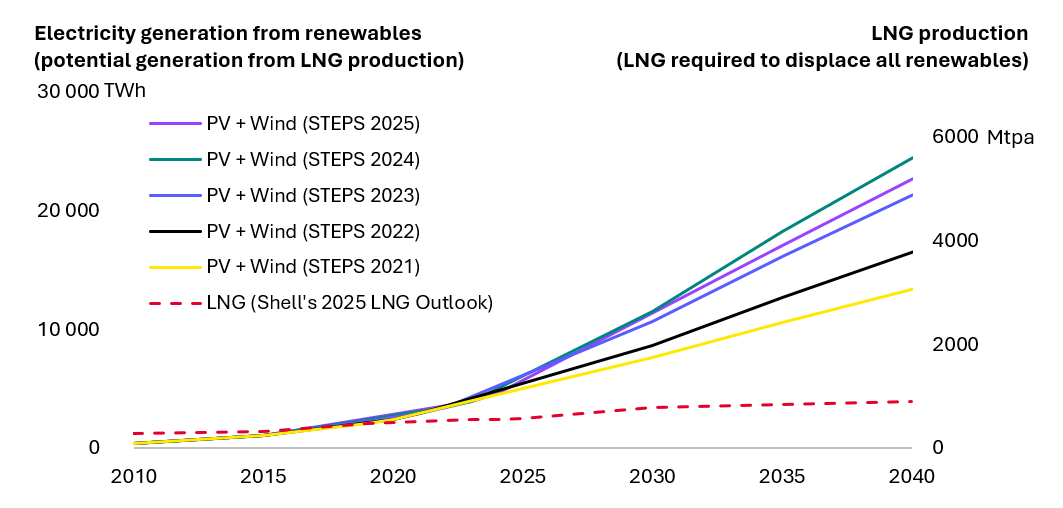
The scale and pace of renewable growth calls into question the centrality of LNG in the future energy system. By 2035, solar and wind are expected to produce around five times as much energy as LNG on an electricity-equivalent basis under the IEA's Stated Policies Scenario (STEPS) (reflecting the direction of travel of the energy system under current policy settings), while Shell's LNG projection shows relatively modest growth through to 2040 (Figure 1). Current policy settings point towards an increasingly renewable-led energy system, with gas playing a limited role.
Figure 1: Solar and wind will soon dwarf the energy provided by LNG
Source: ACCR Analysis of Rystad Energy, Shell’s 2025 LNG Outlook and IEA data. Conclusions are ACCR’s.
It is likely that future policy change will further diminish LNG’s role in the energy mix. The IEA has repeatedly revised its STEPS projections upwards for solar and wind (Figure 1), reflecting rapid cost declines[3] and record deployment rates.[4] Between 2021 and 2025, projected solar and wind generation in 2040 increased by 70% under STEPS.[5] Future projections may see renewables pull further away from LNG. Recent oil and gas supply shocks have also highlighted the risks of relying on imported fossil fuels, leading many countries to accelerate investment in domestic sources of renewable energy that are increasingly viewed as cheaper, more secure and more resilient.
Shell considers that LNG has an important role to play in “support[ing] the energy transition, by displacing more carbon-intensive fuels like coal and oil”[6] in fast-growing, coal-dependent economies. However, the transition pathways observed across many gas-importing countries suggest that renewable energy is reducing coal use directly, without a corresponding increase in gas demand.
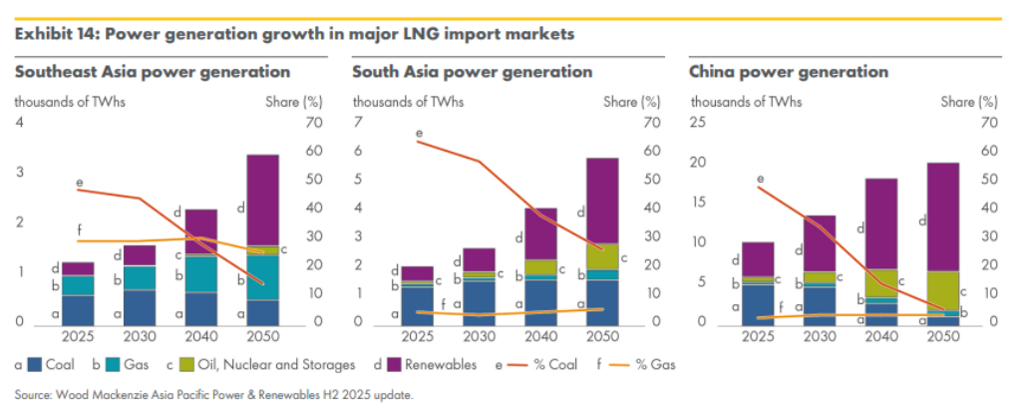
In Asia, renewables are expected to be the primary driver of coal displacement. Shell suggests that LNG will be needed to replace coal in developing countries in Asia, but does not acknowledge projected changes in energy mixes, which point to a limited role for LNG. Their own graph shows renewable energy increasing rapidly in South Asia, China and Southeast Asia, while gas demand increases only modestly in South Asia and China. Further, despite growth in Southeast Asia, gas still loses market share by 2050 (Figure 2).[7] The most significant change in these markets is the exponential growth of renewable generation.
Figure 2: Shell’s Spotlight shows renewables taking market share in target import markets
Source: Shell, LNG Portfolio: Strategic Spotlight, Exhibit 14, p. 8.
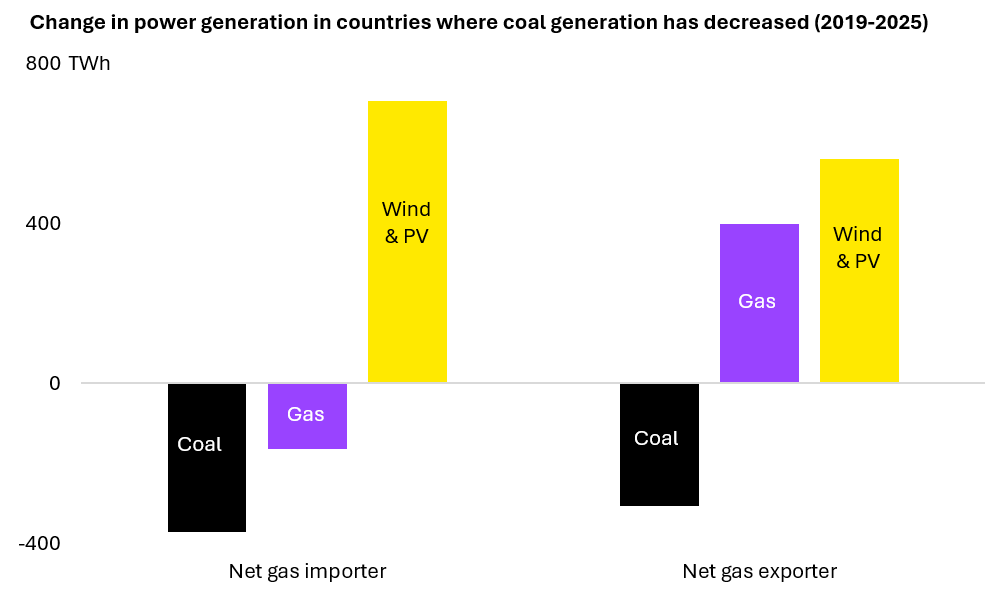
Our analysis shows that LNG does not typically displace coal (Figure 3). We examined 44 countries (36 gas-importing, 8 gas-exporting) that experienced declines in coal-fired electricity generation between 2019 and 2025, and found:
Figure 3: Gas importers are replacing both coal and gas with renewables
Source: ACCR analysis based on Ember and Rystad Energy data. Conclusions are ACCR’s.
These findings suggest that renewable energy, rather than LNG, is driving most of the displacement in coal. Where coal-to-gas switching occurs, it is largely confined to countries with abundant domestic gas resources. In contrast, most gas-importing countries are reducing both coal and gas generation as renewable energy expands.
The economic case for displacing coal with renewables and batteries, rather than LNG, is becoming stronger as costs continue to fall. Between 2019 and 2025, the cost of electricity generated by solar fell by 40%, utility-scale batteries by almost 70% and onshore wind by more than 35%.[8] Renewable energy and storage costs are expected to continue declining, while the cost of electricity generated by LNG is projected to remain broadly flat.[9]
Shell's LNG outlook relies on LNG retaining a role as a “vital balancing fuel for the energy system”[10] as it electrifies. However, evidence from electricity markets suggests that renewables and batteries are capturing a growing share of the generation and firming roles Shell expects LNG to perform.
Generation
Shell positions the relationship between LNG and renewables as complementary, stating that “LNG growth is not in competition with renewables but supports the energy transition”.[11] In practice, they compete for many of the same generation opportunities, with investment often flowing towards lower-cost renewable generation. Our analysis shows that where gas-exporting countries (with access to cheap gas) displace coal, it is typically with a mix of renewables and gas. Gas-importing countries (that face higher gas prices) tend to displace both coal and gas with renewables (Figure 3).
Shell notes that gas plays a “structurally important role”[12] in several Asian electricity markets and expects that gas demand, supplied increasingly through LNG, will continue to grow. However, renewables are capturing an increasing share of electricity generation in these markets, meeting demand that was previously supplied by gas. In Pakistan, for example, a boom in solar deployment triggered by the 2022 surge in global gas prices has reduced reliance on imported LNG. From 2021 to 2025, gas-fired electricity generation fell from 49 TWh to 39 TWh, while solar increased from 6 TWh to 37 TWh.[13]
Low utilisation rates of gas-fired power plants do not necessarily create a long-term role for LNG given increasing competition from renewables. Shell highlights low utilisation across Asia, arguing that operating the plants with LNG can help avoid investment in new capacity.[14] However, the economics of gas-fired generation are largely determined by fuel costs. Even where gas infrastructure already exists, investing in new renewable generation will often be more attractive than relying on high-cost LNG imports to keep existing plants operating. There is evidence of this occurring in India. From 2021 to 2025, utilisation of gas-fired power plants fell from 23.3% to less than 14.5%.[15] Over the same period, gas-fired electricity supply fell from 4% to 2%, while solar and wind increased from 8% to 14%.[16] As renewable deployment increases, utilisation rates of gas-fired power plants may fall further, limiting their contribution to future electricity systems.
Balancing
The need to balance renewable electricity is increasingly being met by batteries rather than LNG-fuelled power generation, reducing the role available to LNG as a balancing fuel.
The IEA has repeatedly revised its projections for battery storage upwards as deployment has outpaced expectations. Global battery capacity in 2025 was three times higher than the level expected by STEPS 2019, while expected capacity in 2035 increased by 500% between STEPS 2019 and 2025.[17]
While batteries are not identical replacements for gas-fired power generation, they are increasingly eroding the amount of gas required to firm renewable electricity systems. The significant cost advantage of batteries is expected to widen further, suggesting that batteries will capture an increasing share of balancing and firming services over time, diminishing LNG’s role.
Download a PDF of Shell LNG Series Part 1: LNG's role in the power sector is diminishing
Shell plc, LNG Portfolio: Strategic Spotlight, March 2026, p. 3, https://www.shell.com/investors/investor-presentations/_jcr_content/root/main/section_1529014047_c_540020954/tabs/tab_1774293805/text_copy_copy_16298_313993862/links/item0.stream/1773644841391/3328e7b37c74c7757cb1c3756fb96ad299de4988/lng-portfolio-strategic-spotlight-2026.pdf. ↩︎
Ibid, p. 6. ↩︎
International Renewable Energy Agency (IRENA), Renewable power generation costs in 2025, p. 15, https://www.irena.org/-/media/Files/IRENA/Agency/Publication/2026/Jul/IRENA_TEC_RPGC_in_2025_2026.pdf. ↩︎
Ember, Global Energy Review 2025, p. 13, https://ember-energy.org/app/uploads/2025/04/Report-Global-Electricity-Review-2025.pdf. ↩︎
See Figure 1. ↩︎
Shell plc, LNG Portfolio: Strategic Spotlight, March 2026, p. 8, https://www.shell.com/investors/investor-presentations/_jcr_content/root/main/section_1529014047_c_540020954/tabs/tab_1774293805/text_copy_copy_16298_313993862/links/item0.stream/1773644841391/3328e7b37c74c7757cb1c3756fb96ad299de4988/lng-portfolio-strategic-spotlight-2026.pdf. ↩︎
Ibid. ↩︎
BloombergNEF (BNEF), The State of the Energy Transition, May 18, 2026, p. 13 (Client access only). ↩︎
ACCR analysis of BNEF data. ↩︎
Shell plc, LNG Portfolio: Strategic Spotlight, March 2026, p. 3, https://www.shell.com/investors/investor-presentations/_jcr_content/root/main/section_1529014047_c_540020954/tabs/tab_1774293805/text_copy_copy_16298_313993862/links/item0.stream/1773644841391/3328e7b37c74c7757cb1c3756fb96ad299de4988/lng-portfolio-strategic-spotlight-2026.pdf. ↩︎
Ibid, p. 8. ↩︎
Ibid. ↩︎
ACCR analysis of Ember yearly electricity data, https://ember-energy.org/data/yearly-electricity-data/. ↩︎
Shell plc, LNG Portfolio: Strategic Spotlight, March 2026, p. 8, https://www.shell.com/investors/investor-presentations/_jcr_content/root/main/section_1529014047_c_540020954/tabs/tab_1774293805/text_copy_copy_16298_313993862/links/item0.stream/1773644841391/3328e7b37c74c7757cb1c3756fb96ad299de4988/lng-portfolio-strategic-spotlight-2026.pdf. ↩︎
Reynolds, Sam, et al., Can LNG Displace Coal Demand in India?, Institute for Energy Economics and Financial Analysis, June 2025, p. 17, https://ieefa.org/sites/default/files/2025-06/Can LNG Displace Coal Demand in India.pdf. ↩︎
ACCR analysis of Ember yearly electricity data, https://ember-energy.org/data/yearly-electricity-data/. ↩︎
ACCR, Investor Bulletin: IEA 2025 World Energy Outlook, November 2025, https://www.accr.org.au/insights/investor-bulletin-iea-2025-world-energy-outlook. ↩︎