4th June 2026
This communication is for informational purposes only and does not constitute financial, legal, or professional advice. ACCR does not hold an Australian Financial Services Licence and does not provide financial product advice. The purpose of this communication is not to provide financial product advice. Please read the terms and conditions attached to the use of this site.
Climate scenarios are back in the spotlight. In recent weeks, you may have seen growing discussion of RCP8.5 and its successor, SSP5‑8.5.
In April 2026, scientists with the Coupled Model Intercomparison Project (CMIP) published a paper with a new set of scenarios for the Intergovernmental Panel on Climate Change’s (IPCC) next major reports.
These scenarios are used by scientists and policy makers to explore plausible trends in socioeconomics, technology and policy – and the resulting emissions, warming and climate impacts. They are not predictions, but pathways to study possible climate futures.
In the new generation of scenarios, RCP8.5 has been phased out. This scenario was built to explore the consequences of high emissions where nations expand fossil fuel use and make no effort to reduce them. By 2100, carbon dioxide levels would almost triple, with global temperatures around 4.5°C hotter than the pre-industrial reference period.
When RCP8.5 was first published in 2011, global emissions were accelerating. In the period since, rapid declines in the cost of clean energy have significantly bent the emissions curve down. This means that RCP8.5 is no longer plausible and it now the most expensive pathway for energy production.
While RCP8.5 has been retired, high warming scenarios could still occur. In the revised scenarios, none keep warming below 1.5°C in the short to medium-term. The updated high emissions scenario projects temperatures of 3.3°C by 2100. If countries deliver on their on current policies, the most likely outcome is 2.6°C.
These warming levels would result in impacts that threaten food and energy systems, economic stability and our means to adapt.
Warming above 1.5°C increases the risk of rapid and potentially irreversible tipping points. Known climate tipping points include the loss of the Greenland and West Antarctic ice sheets, the dieback of warm-water coral reefs, and the collapse of the Atlantic Meridional Overturning Circulation (AMOC)
Clearly, the revised scenarios show the need to transition to renewable energy and limit overshoot is more urgent than ever before.
The lowest risk and cheapest option for the world is to decarbonise at pace, and limit the extent and time we spend above 1.5°C.
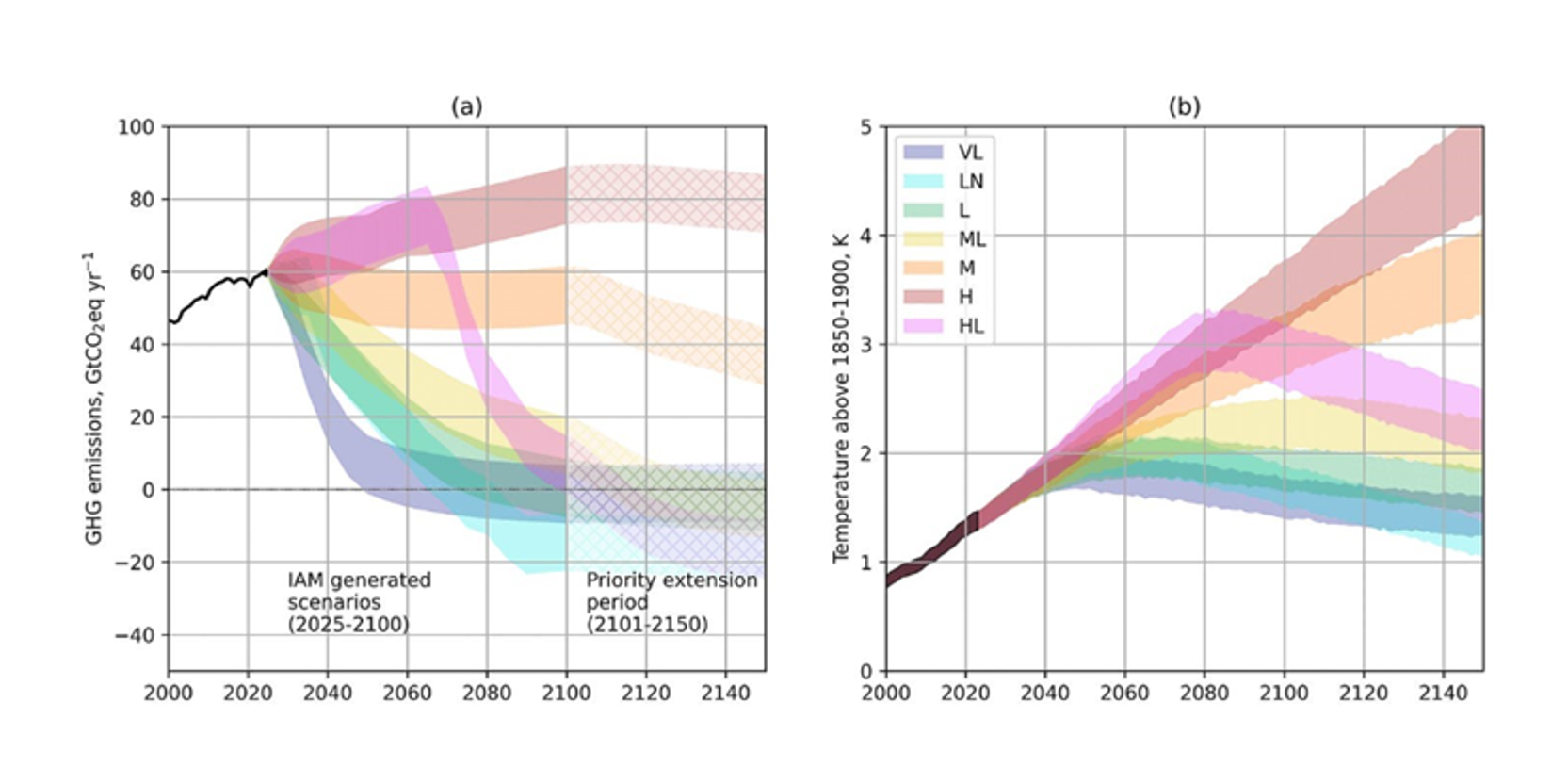
The left panel shows emissions for each of the CMIP7 scenarios, the right panel shows the associated warming increase. Graph by Van Vuuren et al. (2026).