10th March 2026
Publication Information
Download Publication
- 697 KB PDF
- 10th March 2026
Stay Informed
Get email updates about new ACCR research and shareholder advocacy on specific topics of interest to you.
Sign UpThis communication is for informational purposes only and does not constitute financial, legal, or professional advice. ACCR does not hold an Australian Financial Services Licence and does not provide financial product advice. The purpose of this communication is not to provide financial product advice. Please read the terms and conditions attached to the use of this site.
Dr Sophie Lewis, Chief Scientist - Engagement
The topic front of mind for investors in recent conversations is how to approach physical climate risk when assessing future portfolio resilience.
Two questions I’ve been consistently asked in investor meetings are: what level of future warming is most likely? And what sort of climate shocks should we expect in this scenario?
From the climate science perspective, we can’t tackle meaningful climate risk planning without thinking about the risks of high-impact, low-probability events. In complex systems characterised by uncertain tipping points that will bring irreversible change, it is the tail that drives the risk, not the average.
If we start by exploring the most likely warming scenarios and assessing the most likely impacts, we risk overlooking high-impact events that are critical to understanding asset, company, industry, economic and portfolio resilience.
Instead of thinking about the most likely future climate outcomes, the question we should first ask is: what happens if the tail materialises, and are we robust to it?
This broad concept of tail risks – the rarest, most extreme events – will be familiar to all of us. Within the climate science community, unprecedented weather events, a compounding series of events, as well as tipping points are all regarded as tail events.
Tail risks play a larger role in the climate risk envelope than their low likelihoods might suggest because of their disproportionately costly impacts. In recent decades, we've seen these risks change as global temperatures increase. With any increase in future warming – whether we reach 1.5°C, 2°C, or 3°C – many types of events that we used to consider tail risks will become more common, and future tail risks will become even more extreme.
The chart below depicts this concept. A flood event that was ‘extreme’ in 1980 is moving into the realm of ‘likely’ today, and as temperatures rise further, more frequent and severe floods are expected.
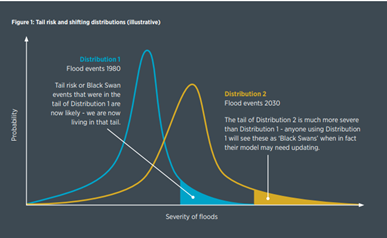
Figure 1: If we look at the changing intensity and likelihood of flood events over recent decades with climate change, we often see very large changes in the tail. Source: Institute and Faculty of Actuaries.
Working through the variety of climate risks that we can consider tail events, I'll start with three recent examples of record-breaking tail events, or Black Swans:
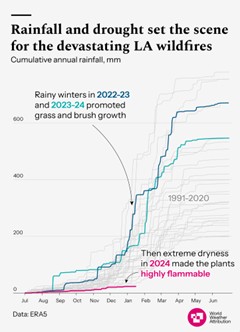
Figure 2: The LA fires followed a ‘climate whiplash’ event, involving two wet winters followed by an extremely dry one, resulting in huge amounts of flammable vegetation. Source: World Weather Attribution.
Back-to-back or simultaneous weather events – known as compound events – can be particularly impactful. Examples include an extreme heatwave followed by bushfires, or being hit by a series of damaging storms, as occurred in Spain, Portugal and Morocco during January and February, with nine named storms in 32 days.
Compound events can push beyond the design limits of buildings, roads, energy systems, and other infrastructure are built to withstand, and result in cascading system failures. Increasing global temperatures is loading the climate dice, making compound events and cascading, systemic climate risks more likely with every fraction of a degree of warming.
Tipping points are well known tail risks. When critical thresholds in the climate system are breached, abrupt and often irreversible changes can occur. Once a threshold is passed, systems like ice sheets, the Atlantic oceanic circulation or Amazon rainforest can be pushed into and remain in a new state, even if warming halts.
December 2025’s newsletter detailed that we have already crossed the tipping point for coral reef systems and that without a significant, rapid reduction of greenhouse gas emissions, many more systems risk tipping into a dangerous state. The expected impacts of tipping points include massive sea level rise, extreme cold in Europe, more destructive hurricanes and abrupt carbon release from permafrost.
Today, a country or city might be able to cope with an occasional tail event through strong adaptation and resilience planning. However, as warming continues, tail events in many regions will become so extreme that some systems will no longer be able to keep up.
Instead of focusing on the ‘most likely’ levels of warming and the ‘most likely’ impacts, we need to start by thinking about tail risks and what happens if they materialise. Applying this full risk spectrum approach to physical climate risks means a broader set of questions in risk assessments is required. Questions include:
By expanding our consideration of physical climate risks, we can better assess resilience to future warming and whether portfolio companies are resilient to high-impact climate risks.
In my next Climate Science Insight, I’ll discuss how a narrow focus on direct climate risks can cause us to miss the biggest climate risk: systemic risk. Direct risks of climate change – such as floods damaging a factory, sea level rise eroding coastal roads, or droughts affecting water supplies – are often just one part of the total risk envelope that needs to be considered. A larger concern is systemic climate risks, where impacts cascade and compound across systems and regions, causing widespread supply chain disruptions and ripple effects.
Get email updates about new ACCR research and shareholder advocacy on specific topics of interest to you.
Sign Up