17th August 2026
Publication Information
Download Publication
- 2 MB PDF
- 17th August 2026
This communication is for informational purposes only and does not constitute financial, legal, or professional advice. ACCR does not hold an Australian Financial Services Licence and does not provide financial product advice. The purpose of this communication is not to provide financial product advice. Please read the terms and conditions attached to the use of this site.
Submission to the NSW Independent Planning Commission Panel
HVO North and South Open Cut Coal Continuation Projects
(SSD-11826681 & SSD-11826621)
a. the Projects will generate a net economic benefit to NSW that is significantly less than what has been represented by HVO Operations Pty Ltd (the Proponent);
b. the Projects will materially impede the achievement of NSW's legislated emissions reduction targets;
c. the Proponent's proposed emissions reduction strategy is uncertain and largely dependent on offsets and unproven technology; and
d. the Projects are consistent with over 2°C of warming, which will cause significant environmental and social impacts, in the locality and region.
a. report prepared by Mr Pranav Dayal dated 5 August 2026;
b. report prepared by Dr Dimitri Lafleur dated 24 July 2026; and
c. report prepared by Dr Sophie Lewis dated 31 July 2026.
The Commission is the consent authority in respect of the development applications for the Projects as provided by s 4.5(a) of the Environmental Planning and Assessment Act 1979 (NSW) (the EPA Act) and cl 8A of the State Environmental Planning Policy (State and Regional Development) 2011 (NSW).
The following matters must be taken into account in determining the development applications:
a. any environmental planning instruments that apply to the land to which the development applications relate;[1]
b. the significant likely impacts of the developments, including environmental impacts on both the natural and built environments, and social and economic impacts in the locality;[2]
c. any submissions made in accordance with the EPA Act or the associated regulations;[3]
d. whether the proposed developments are in the public interest;[4]
e. whether any consent should be issued subject to conditions aimed at ensuring that the development is undertaken in an environmentally responsible manner, including conditions to ensure that greenhouse gas emissions are minimised to the greatest extent practicable;[5] and
f. an assessment of the greenhouse gas emissions (including downstream emissions) of the proposed developments, having regard to any applicable State or national policies, programs or guidelines concerning greenhouse gas emissions.[6]
Relatedly, the Commission's determination of the development applications must be guided by the objects of the EPA Act, which include:
a. the promotion of the social and economic welfare of the community and a better environment by the proper management, development and conservation of the State natural and other resources;[7]
b. the promotion of resilience to climate change and natural disasters through adaptation, mitigation, preparedness and prevention;[8]
c. the facilitation of ecologically sustainable development by the integration of relevant economic, environmental and social considerations in decision-making about environmental planning and assessment;[9]
d. the promotion of a proportionate and risk-based approach to environmental planning and assessment;[10] and
e. the promotion of the orderly and economic use and development of land.[11]
Following the passage of the Climate Change (Net Zero Future) Act 2023 (NSW), the NSW Government and Net Zero Commission have also emphasised that consent authorities should consider the State's legislated greenhouse gas emissions reduction targets in the course of their decision-making.[12]
As the consent authority and relevant decision-maker, the Commission must weigh and balance the above listed factors, including the social, economic and environmental benefits (and any detriments) of the Projects, to determine whether the Projects should proceed. The remainder of this submission addresses matters relevant to these mandatory considerations.
Figure 1
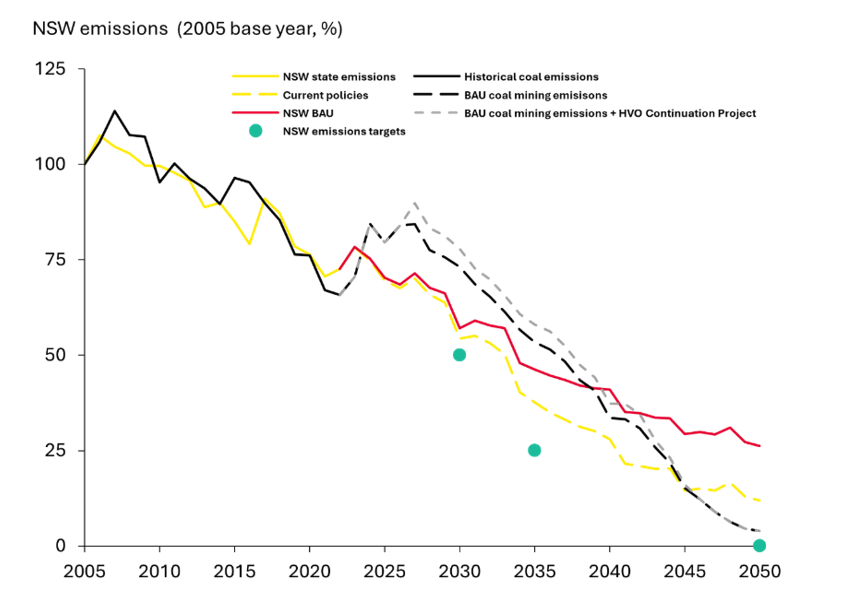
Source: ACCR analysis of NSW greenhouse gas emissions projections 2024: methods paper (Figure 1, 21, 24), HVO GHG Assessment.
Figure 2
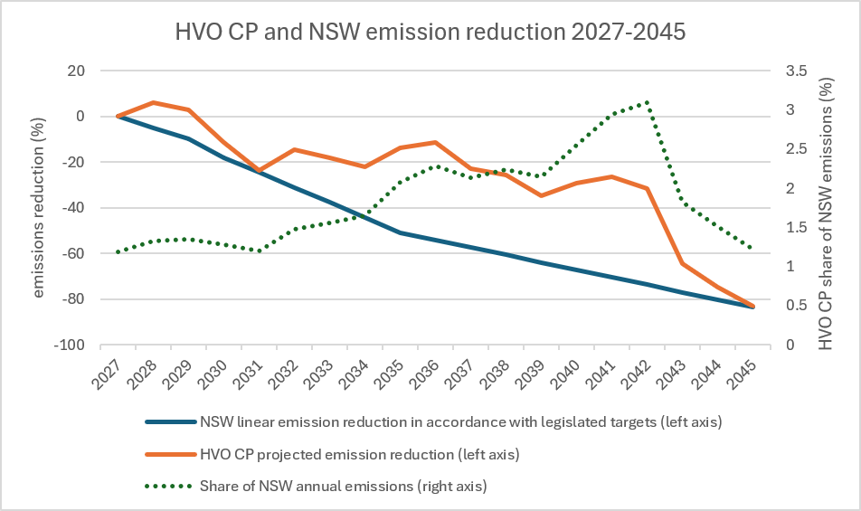
ACCR analysis of the Projects' share of NSW annual emissions between 2027 and 2045 (green dotted line). Projected scope 1 and 2 emissions (in orange); linear projected NSW annual emissions based on legislated targets (in dark blue). Both HVO CP and NSW emission reductions have been rebased to 2027. Data sources: Australia's National Greenhouse Accounts (2026); EMM, Hunter Valley Operations (2025) Hunter Valley Operations Continuation Project Amendment Report, Appendix E.
In addition to considering the impact that the Projects will have on NSW's emissions reduction targets, the Commission must give due weight to the impact that the Projects' actual cumulative GHG emissions will have on temperature outcomes and the resulting climate-related impacts. As detailed below, the Projects will make a substantial contribution to cumulative global GHG emissions and are consistent with warming above 2°C. The measures proposed to mitigate the Projects' GHG emissions are also uncertain, unproven and inconsistent with the need for real emissions reduction in the near term.
The Projects are expected to generate at least 809 Mt of carbon dioxide equivalent (CO2-e) cumulative scope 1, 2 and 3 GHG emissions.[43] These emissions would constitute a material contribution to global and localised warming, and associated climate-related impacts. In his report, Dr Lafleur emphasises that available scientific evidence indicates that existing and approved global fossil fuel developments already exceed the remaining carbon budget consistent with limiting warming to below 2°C.[44] If approved, the Projects would add cumulative emissions to an already over-allocated carbon budget and can therefore be considered consistent with warming exceeding 2°C.
This level of projected warming and the significant climate, environmental, social and economic impacts associated with more than 2°C should weigh heavily against the approval of the Projects being in the public interest.
This submission gains greater force when the fact that the Projects' estimated fugitive emissions have likely been understated is taken into account.[45]
Pursuant to s 2.20(2) of the State Environmental Planning Policy (Resources and Energy) 2021 (NSW), the Commission is required to consider an assessment of the GHG emissions of the Projects. The Proponent relies on an Air Quality and Greenhouse Gas Assessment, which estimates that the Projects will generate 35.16 Mt CO2-e scope 1 and 2 emissions over their total life.[46] However, this assessment likely presents an incomplete picture of the Projects' future emissions.
As discussed by Dr Lafleur in his report, there is a high likelihood that the Projects' scope 1 emissions have been materially underestimated.[47] In 2025, a satellite study showed that the actual detected emissions from the Hunter Valley and Illawarra coal fields (representing 60% of NSW coal production and including the Proponent's existing mine area) were double the emissions that were officially reported.[48] This undermines the reliability of the Proponent's existing GHG emissions assessment and raises questions about the adequacy of any approval conditions or mitigation measures that have been proposed on the basis of the existing emissions assessment.
There are also several issues with the measures that have been proposed for reducing the Projects' emissions:
a. It is widely accepted that there is no proven technology available to effectively mitigate fugitive emissions from an open-cut coal mine. The Proponent has committed to undertaking a feasibility trial for the pre-drainage of gas in gas domain 3 of the Projects, but this technology remains experimental in nature and there is no guarantee of its success.[49]
b. Based on the information available about the Projects, a final decision on whether pre-drainage will form part of the Proponent's mitigation strategy may not occur until around 2030. It would be inconsistent with EPA guidelines and priorities to delay the decision on pre-drainage by up to three years. If the Projects are approved and commence before any final decision regarding pre-drainage is made, there will be a risk as time passes that any pre-drainage could become ineffective and even commercially unviable if gas concentrations are too low.[50]
c. The Proponent has not committed to meaningful diesel decarbonisation despite the EPA's guidance identifying this as a major opportunity for emissions reduction.[51]
d. Even if methane emissions reduction is achieved, the Project is expected to facilitate approximately 780 Mt CO2-e of scope 3 emissions from coal combustion. This scale of downstream emissions is inconsistent with the State's stringent climate mitigation objectives and reduces the overall benefit of any methane reduction that is ultimately achieved.[52]
The Projects' emissions are consistent with warming exceeding 2°C and the evidence indicates that the Projects lack a credible, proven or timely strategy for avoiding or substantially reducing GHG emissions. In these circumstances, the Commission cannot be satisfied that the GHG emissions of the Projects will be effectively or adequately mitigated, nor that the Projects are consistent with the public interest and with principles of ecologically sustainable development.
For the avoidance of doubt, any submission that the Projects' emissions may represent a small fraction of the global total of GHG emissions or that some other hypothetical and uncertain alternative fossil fuel development may produce the same GHG emissions instead is no answer to the projected adverse impacts. In Gloucester Resources Limited v Minister for Planning,[53] Preston CJ rejected similar arguments made by the proponent of the Rocky Hill Coal Project and held that the mine should be refused due to its unacceptable impacts that could not be satisfactorily mitigated.
In his reasons for judgment, Preston CJ noted:
[515] ... In aggregate, the Scope 1, 2 and 3 emissions over the life of the [Rocky Hill Coal] Project will be at least 37.8Mt CO2-e, a sizeable individual source of GHG emissions. It matters not that this aggregate of the Project's GHG emissions may represent a small fraction of the global total of GHG emissions. The global problem of climate change needs to be addressed by multiple local actions to mitigate emissions by sources and remove GHGs by sinks...
[516] Many courts have recognised this point that climate change is caused by cumulative emissions from a myriad of individual sources, each proportionally small relative to the global total of GHG emissions and will be solved by abatement of the GHG emissions from these myriad of individual sources.
[545] There is also a logical flaw in the market substitution assumption. If a development will cause an environmental impact that is found to be unacceptable, the environmental impact does not become acceptable because a hypothetical and uncertain alternative development might also cause the same unacceptable environmental impact. The environmental impact remains unacceptable regardless of where it is caused. The potential for a hypothetical but uncertain alternative development to cause the same unacceptable environmental impact is not a reason to approve a definite development that will certainly cause the unacceptable environmental impacts. In this case, the potential that if the [Rocky Hill Coal] Project were not to be approved and therefore not cause the unacceptable GHG emissions and climate change impacts, some other coal mine would do so, is not a reason for approving the Project and its unacceptable GHG emissions and climate change impacts.
Should the Commission accept that the scope 1, 2 and 3 emissions resulting from the Projects will contribute to global climate change, the Commission is required by s 4.15(1)(b) of the EPA Act to consider the resulting environmental impacts that will be experienced in the locality of the Projects.[54] ACCR submits that the Projects' cumulative emissions will have an unacceptable impact on the climate system and environment of the Hunter region, in turn causing cascading social and economic impacts in the locality.
As noted above with reference to Dr Lafleur's report, the cumulative emissions of the Projects are consistent with more than 2°C of global warming. It is therefore appropriate to consider the local environmental and climate-related impacts that will be experienced in the Hunter region, being the locality of the Projects, if the threshold of 2°C in global warming is breached.
The report of Dr Sophie Lewis (attached as Annexure C) details the causal link between GHG emissions, the increase in global temperatures, and regional and local climatic impacts. In summary:
a. The Hunter region bears several features that make it specifically vulnerable to climate change, and it includes one of the largest and most flood-prone floodplains in NSW.[55]
b. If global temperatures increase by 2°C by 2050, the Hunter region will likely experience at that time:
i. a significant increase in the frequency and intensity of heat extremes, including seven more days each year where maximum temperatures exceed 35°C, compared to the 1990-2009 average;
ii. considerable changes in rainfall, including an overall decrease in average rainfall by 9% and an increase in the intensity of heavy rainfall events;
iii. increased exposure to sea level rise of between 14 and 31 centimetres, and associated hazards including coastal erosion, estuarine inundation and coastal overwash; and
iv. increased severe fire weather days.[56]
c. These climate hazards will compound and cascade, dramatically increasing various social, economic and public health-related risks in the Hunter region. Cascading impacts that will likely be felt by the local population include increasing heat-related illness and mortality, disruption to the agricultural industry, reduced productivity in industries that rely on outdoor workers, and infrastructure-related hazards.[57]
The Commission's decision-making must be guided by the objects of the EPA Act, which include 'the promot[ion of] the social and economic welfare of the community and a better environment by the proper management, development and conservation of the State's natural and other resources'.[58] ACCR submits that the projected impacts described above will undermine the social and economic welfare of the community. The Projects would be a damaging use of the State's resources.
Developments in scientific attribution methods have also enabled the GHG emissions of fossil fuel projects to be causally linked to specific amounts of additional global warming and, by extension, specific regional climate consequences. In her report, Dr Lewis applies this methodology to the Projects and concludes that the following future impacts in NSW would be directly attributable to the fraction of warming caused by the Projects' total emissions:
a. at least one excess heat-related death in NSW over the period 2060-2079;
b. an annual cost of up to $680,000 to community and businesses in Western Sydney by 2080; and
c. a reduction of at least 29 jobs in NSW by 2070.[59]
These are serious, significant and irreversible social, economic and health-related impacts in NSW that can be attributed to the Projects that the Commission should have regard to. In ACCR's submission, the approval conditions suggested by the Department will not adequately mitigate the risk of these impacts.
The Proponent's development applications and related material do not meaningfully address the climate change impacts that will result in the locality and NSW more widely from the Projects' total cumulative emissions. The risk of these impacts occurring can only be mitigated by the reduction of actual GHG emissions or the effective permanent removal of CO2 from the atmosphere.
As noted by Dr Lafleur in his report, opportunities to use offsets and to mitigate fugitive emissions are limited in availability and effectiveness. There is also limited evidence that the Proponent will take measures to meaningfully reduce diesel emissions associated with the Projects, and no evidence that the Projects' substantial scope 3 emissions will be mitigated. In these circumstances, the Commission cannot be satisfied that the approval of the Projects would be in the public interest, nor consistent with the guiding principles of the Climate Change (Net Zero Future) Act 2023 (NSW).
Download Submission: HVO North and South Open Cut Coal Continuation Projects
Annexure A: Report of Mr Pranav Dayal dated 5 August 2026
Annexure B: Report of Dr Dimitri Lafleur dated 24 July 2026
Annexure C: Report of Dr Sophie Lewis dated 31 July 2026
EPA Act s 4.15(1)(a)(i). ↩︎
EPA Act s 4.15(1)(b). ↩︎
EPA Act s 4.15(1)(d). ↩︎
EPA Act s 4.15(1)(e). ↩︎
State Environmental Planning Policy (Resources and Energy) 2021 (NSW) s 2.20(1)(c). ↩︎
State Environmental Planning Policy (Resources and Energy) 2021 (NSW) s 2.20(2). ↩︎
EPA Act s 1.3(a). ↩︎
EPA Act s 1.3(e). ↩︎
EPA Act s 1.3(i); see also the principles of ecologically sustainable development set out in Environmental Planning and Assessment Regulation 2021 (NSW) s 193, which include the precautionary principle, intergenerational equity, the conservation of biological diversity and ecological integrity, and improved valuation, pricing and incentive mechanisms. ↩︎
EPA Act s 1.3(j). ↩︎
EPA Act s 1.3(k). ↩︎
See: emissions reduction targets in s 9(1) of the Climate Change (Net Zero Future) Act 2023 (NSW); Net Zero Commission, Coal Mining Emissions Spotlight Report (December 2025) p. 37; https://www.netzerocommission.nsw.gov.au/sites/default/files/2025-12/NZC_Coal_Spotlight_Report_2025.pdf Net Zero Commission, Letter to Independent Planning Commission (26 September 2025) p. 2; https://www.netzerocommission.nsw.gov.au/sites/default/files/2025-10/NZC-2025-Letter-to-Independent-Planning-Commission.pdf Penny Sharpe MLC, Letter to the Minister for Planning and Public Spaces (20 May 2024). https://majorprojects.planningportal.nsw.gov.au/prweb/PRRestService/mp/01/getContent?AttachRef=RFI-75053457!20240822T212408.030+GMT ↩︎
Report of Pranav Dayal dated 5 August 2026, [25]-[26]. ↩︎
Ernst & Young, Economic Impact of the Hunter Valley Operations Continuation Project HV Operations Pty Ltd (4 August 2025), pp. 3, 46. https://majorprojects.planningportal.nsw.gov.au/prweb/PRRestService/mp/01/getContent?AttachRef=SSD-11826681!20250807T013252.255+GMT ↩︎
NSW Government, Guidelines for the Economic Assessment of Mining and Coal Seam Gas Proposals (December 2015); https://www.planning.nsw.gov.au/sites/default/files/2023-03/guidelines-for-the-economic-assessment-of-mining-and-coal-seam-gas-proposals.pdf NSW Government, Technical Notes Supporting Guidelines for the Economic Assessment of Mining and Coal Seam Gas Proposals (April 2018); https://www.planning.nsw.gov.au/sites/default/files/2023-03/technical-notes-supporting-guidelines-economic-assessment-mining-coal-seam-gas-proposals.pdf NSW Treasury, TPP17-03 Guide to Cost-Benefit Analysis (March 2017). https://arp.nsw.gov.au/assets/ars/393b65f5e9/TPP17-03_NSW_Government_Guide_to_Cost-Benefit_Analysis_0.pdf ↩︎
NSW Treasury, TPG24-34 Carbon Emissions in the Investment Framework (December 2024); https://www.nsw.gov.au/sites/default/files/noindex/2025-03/tpg24-34-carbon-emissions-in-the-investment-framework.pdf NSW Treasury, TPG23-08 NSW Government Guide to Cost-Benefit Analysis (February 2023, updated in April 2025). https://www.nsw.gov.au/sites/default/files/noindex/2025-03/tpg23-08-nsw-government-guide-to-cost-benefit-analysis.pdf ↩︎
NSW Treasury, TPG24-34 Carbon Emissions in the Investment Framework (December 2024) p. 8. https://www.nsw.gov.au/sites/default/files/noindex/2025-03/tpg24-34-carbon-emissions-in-the-investment-framework.pdf ↩︎
Ibid, p. 4. ↩︎
NSW Independent Planning Commission, Transcript of Public Hearing (Day 1): HVO North and South Open Cut Coal Continuation Projects (16 July 2026), 20.40-21.29. ↩︎
Report of Pranav Dayal dated 5 August 2026, [7]-[10]. ↩︎
NSW Department of Planning, Housing and Infrastructure, Hunter Valley Operations Continuation Project. State Significant Development Assessment Report (SSD11826681 and SSD11826621) (June 2026), [480]. https://majorprojects.planningportal.nsw.gov.au/prweb/PRRestService/mp/01/getContent?AttachRef=SSD-11826681!20260612T010800.494+GMT ↩︎
NSW Department of Planning, Housing and Infrastructure, Hunter Valley Operations Continuation Project. State Significant Development Assessment Report (SSD11826681 and SSD11826621) (June 2026), [478]-[480], [490]-[491]. https://majorprojects.planningportal.nsw.gov.au/prweb/PRRestService/mp/01/getContent?AttachRef=SSD-11826681!20260612T010800.494+GMT ↩︎
NSW Department of Planning, Housing and Infrastructure, Hunter Valley Operations Continuation Project. State Significant Development Assessment Report (SSD11826681 and SSD11826621) (June 2026), [482]-[486]. https://majorprojects.planningportal.nsw.gov.au/prweb/PRRestService/mp/01/getContent?AttachRef=SSD-11826681!20260612T010800.494+GMT ↩︎
Ibid, [497]-[498], [515]. ↩︎
Report of Pranav Dayal dated 5 August 2026, [19]-[27]. ↩︎
Report of Pranav Dayal dated 5 August 2026, [26]. ↩︎
Report of Pranav Dayal dated 5 August 2026, [25]. ↩︎
Report of Pranav Dayal dated 5 August 2026, [26]. ↩︎
Report of Pranav Dayal dated 5 August 2026, [27]. ↩︎
Climate Change (Net Zero Future) Act 2023 (NSW) s 9(1). ↩︎
NSW Department of Climate Change, Energy, the Environment and Water, NSW Greenhouse Gas Emissions Projections 2025 Methods Paper (2026), pp. 5-8. https://www.environment.nsw.gov.au/sites/default/files/2026-07/nsw-greenhouse-gas-emissions-projections-2025-260183.pdf ↩︎
Ibid, see Figures 1, 3 and 4. ↩︎
Net Zero Commission, 2026 Annual Progress Report (July 2026), p. 81. https://www.netzerocommission.nsw.gov.au/sites/default/files/2026-07/Net-Zero-2026-Annual-Progress-Report.pdf ↩︎
Net Zero Commission, Annual Report 2024 (November 2024), pp. 18-21. https://www.netzerocommission.nsw.gov.au/sites/default/files/2024-12/NZC 2024 Annual Report_V11.pdf ↩︎
NSW Department of Planning, Housing and Infrastructure, Hunter Valley Operations Continuation Project. State Significant Development Assessment Report (SSD11826681 and SSD11826621) (June 2026), pp. 42-49; https://majorprojects.planningportal.nsw.gov.au/prweb/PRRestService/mp/01/getContent?AttachRef=SSD-11826681!20260612T010800.494+GMT EMM Consulting Pty Ltd, Hunter Valley Operations Continuation Project Amendment Report (August 2025), pp. 76-77. https://majorprojects.planningportal.nsw.gov.au/prweb/PRRestService/mp/01/getContent?AttachRef=SSD-11826681!20250828T033257.503+GMT ↩︎
NSW Environment Protection Agency, NSW Guide for Large Emitters (January 2025), p. 36. https://www.epa.nsw.gov.au/sites/default/files/2025-02/24p4574-nsw-guide-for-large-emitters.pdf ↩︎
NSW Independent Planning Commission, Transcript of Meeting with Net Zero Commission (24 July 2026), 7.39-41. ↩︎
NSW Independent Planning Commission, Transcript of Meeting with NSW Department of Climate Change, Energy, the Environment and Water (14 July 2026), 19.1-14. ↩︎
Report of Dr Dimitri Lafleur dated 24 July 2026, [33]. ↩︎
Ibid. ↩︎
Report of Dr Dimitri Lafleur dated 24 July 2026, [34]-[37]. ↩︎
Report of Dr Dimitri Lafleur dated 24 July 2026, [38]. ↩︎
NSW Department of Planning, Housing and Infrastructure, Hunter Valley Operations Continuation Project. State Significant Development Assessment Report (SSD11826681 and SSD11826621) (June 2026), pp. iii, 45-46. https://majorprojects.planningportal.nsw.gov.au/prweb/PRRestService/mp/01/getContent?AttachRef=SSD-11826681!20260612T010800.494+GMT ↩︎
Report of Dr Dimitri Lafleur dated 24 July 2026, [6]-[13]. ↩︎
Report of Dr Dimitri Lafleur dated 24 July 2026, [12]. ↩︎
Jacobs Group (Australia) Pty Ltd, Hunter Valley Operations Continuation Project: Air Quality and Greenhouse Gas Assessment (9 November 2022) pp. 87-89. https://majorprojects.planningportal.nsw.gov.au/prweb/PRRestService/mp/01/getContent?AttachRef=SSD-11826681!20221219T093437.518+GMT ↩︎
Report of Dr Dimitri Lafleur dated 24 July 2026, [14]-[19]. ↩︎
Report of Dr Dimitri Lafleur dated 24 July 2026, [17]-[18]. ↩︎
Report of Dr Dimitri Lafleur dated 24 July 2026, [25]-[32]. ↩︎
Report of Dr Dimitri Lafleur dated 24 July 2026, [30]-[32]. ↩︎
Report of Dr Dimitri Lafleur dated 24 July 2026, [22]-[24]. ↩︎
Report of Dr Dimitri Lafleur dated 24 July 2026, [31]. ↩︎
Gloucester Resources Limited v Minister for Planning [2019] NSWLEC 7, [514]-[528]; [534]-[545] (Preston CJ). ↩︎
See Denman Aberdeen Muswellbrook Scone Healthy Environment Group Inc v MACH Energy Australia Pty Ltd [2025] NSWCA 163, [107]-[108] (Ward P). ↩︎
Report of Dr Sophie Lewis dated 31 July 2026, [14]-[16]. ↩︎
Report of Dr Sophie Lewis dated 31 July 2026, [17]-[18]. ↩︎
Report of Dr Sophie Lewis dated 31 July 2026, [19]-[23]. ↩︎
EPA Act s 1.3(a). ↩︎
Report of Dr Sophie Lewis dated 31 July 2026, [24]-[27]. ↩︎