2nd November 2026
Publication Information
Download Publication
- 712 KB PDF
- 2nd November 2026
This communication is for informational purposes only and does not constitute financial, legal, or professional advice. ACCR does not hold an Australian Financial Services Licence and does not provide financial product advice. The purpose of this communication is not to provide financial product advice. Please read the terms and conditions attached to the use of this site.
Shell expects LNG demand to grow to meet energy security needs. ACCR analysis finds that two supply shocks in four years have pushed many of LNG's key customers the other way, towards domestic renewables, storage and electrification, and away from imported fuel.
This briefing is Part 3 of ACCR's three-part series testing Shell's LNG demand forecast. Part 1 examines whether LNG is displacing coal in power generation, and Part 2 whether LNG can compete on cost in Shell's growth markets.
Read Part 1: LNG's role in the power sector is diminishing and Part 2: LNG is increasingly uncompetitive.
Shell expects LNG demand will grow to meet energy security needs. However, recent energy crises have changed how many of LNG's key customers think about energy security. Across a growing number of markets, energy users and policymakers are responding to volatile LNG prices and supply risks by accelerating investment in domestic sources of energy, electrification and alternatives to imported fossil fuels.
Two major supply shocks within four years have driven a sharp increase in energy prices, particularly LNG. These shocks have reshaped orthodox thinking around the “energy trilemma” – the challenge of balancing energy security, equity and sustainability. Increasingly, renewable energy, storage and electrification are being viewed not only as decarbonisation solutions, but as ways to reduce exposure to volatile international fuel markets, whereas imported fossil fuels are no longer viewed as inherently secure. Energy sources that rely on stocks (e.g. wind turbines) do not carry the same geopolitical risks as those which rely on flows of energy (e.g. diesel).
Countries in Asia, such as Bangladesh and Pakistan, have experienced significant energy security challenges during recent LNG supply disruptions. Governments were forced to absorb higher costs, manage shortages and implement emergency measures (for example, shorter work weeks) to reduce demand.[1] These experiences are likely to influence future investment decisions.
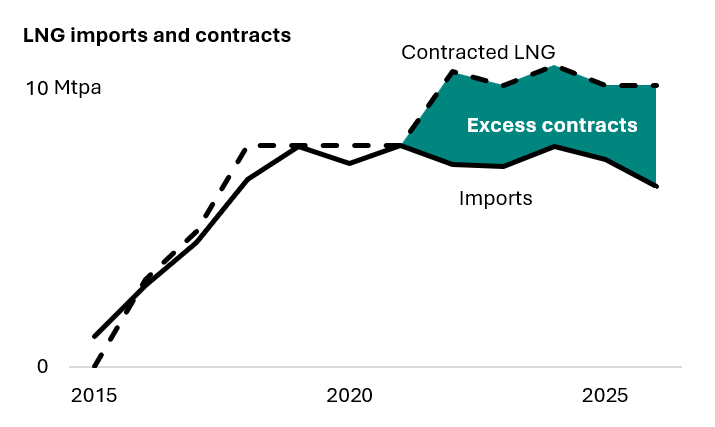
Pakistan illustrates how exposure to LNG market volatility can weaken future LNG demand. During the 2022 energy crisis, the country was priced out of the LNG market by European buyers,[2] contributing to rolling blackouts.[3] Pakistan subsequently increased imports of Chinese solar equipment by 650% between 2021 and 2024,[4] a shift estimated to have saved the country approximately $12 billion in LNG and diesel costs.[5] This is almost twice the $6.6 billion spent on those solar imports.[6] From 2022 to 2025, Pakistan had more contracted LNG than it consumed (Figure 1), and redirected about 30% of its contracted cargoes.
Figure 1: Pakistan redirected about 30% of its contracted cargos between 2022 and 2025
Source: ACCR analysis of Rystad Energy data. Conclusions are ACCR’s.
Prior to Iran's closure of the Strait of Hormuz, LNG markets were widely expected to enter a period of oversupply. While the loss of Qatari and UAE supply temporarily shifted attention towards security of supply, the attention of some commentators is returning to the scale of the expected glut. Approximately 22 million tonnes per annum (Mtpa) of new North American supply is expected in 2026, with another 100 Mtpa already under construction.[7] Whether this new supply is absorbed depends heavily on LNG prices being low enough for the markets Shell expects to drive future demand growth. Yet several of the markets Shell expects will support future LNG demand growth are already meeting a larger share of their energy needs without increasing LNG imports.
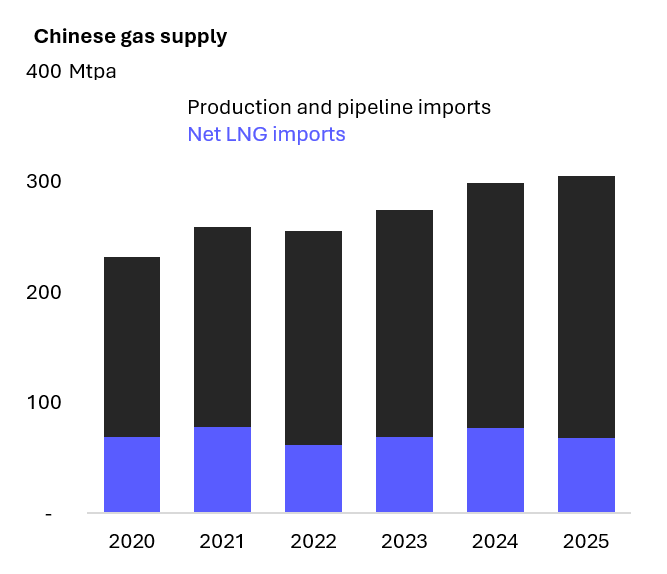
China's LNG imports have plateaued since 2021 despite continued growth in gas demand (Figure 2), due to growth in domestic production and pipeline imports.
Figure 2: While Chinese gas consumption has increased, its LNG imports peaked in 2021
Source: ACCR analysis of Rystad Energy data. Conclusions are ACCR’s.
Shell is optimistic about LNG's growth prospects in Asia and expects a major increase in demand from emerging markets, including Vietnam and Thailand. However, Vietnam and Thailand are expected to achieve just 13% and 36% of their respective 2030 targets for new gas-fired power generation.[8] Both countries are accelerating renewables deployment in response to supply shortages, which will likely limit future LNG demand. Vin Group recently abandoned a 5 GW LNG-to-power plant project in Vietnam and asked the government to consider a renewables and batteries project instead,[9] despite already having commenced construction.[10] Thailand is moving in a similar direction. The Thai energy minister recently stated that “the ongoing conflict in the Middle East demonstrates that we must urgently reduce imports of LNG and other fuels”[11] while announcing a doubling of the 2040 clean energy target.
Prior to the current Middle East disruption, LNG imports were already beginning to stall in countries that Shell sees as pivotal for demand growth. Imports declined in both India and China during 2025, as lower-cost renewable sources of electricity increasingly met growth in energy demand.
The same trend is evident in Europe. The European Commission’s Electrification Action Plan explicitly links electrification with reducing dependence on imported fossil fuels, which it says have “repeatedly exposed our vulnerability to geopolitical shocks”.[12] The Commission aims to increase electrification from 23% of final energy consumption to 46% by 2040, requiring the European economy to electrify roughly nine times faster than it has over the past decade.[13]
The scale of the potential demand impact is significant. The Commission estimates that meeting this target would reduce gas imports by more than 70%,[14] or approximately 150 million tonnes in 2040.[15] Since LNG is more expensive than piped gas and Europe currently imports about 100 million tonnes of LNG,[16] a reduction of this magnitude could displace most of the bloc’s LNG imports. Europe currently imports around a quarter of global LNG production – 50% more than China, the world’s largest LNG importer. Even partial delivery of the Commission's objectives would materially reduce European LNG demand and reshape global LNG markets.
Download a PDF of Part 3: Energy security favours reduced LNG dependence
Government of Pakistan, “Notification,” March 10, 2026, https://dailysubnews.com/wp-content/uploads/2026/03/Notification-10.3.26-1.pdf.\ ↩︎
Ahmad Naeem Sallik, Mian, “Pakistan’s LNG Crisis: an Escalation of Power Crisis,” Institute of Strategic Studies Islamabad Issue Brief, June 28, 2022, p. 1, https://issi.org.pk/wp-content/uploads/2022/06/IB_Salik_Jun_28_2022.pdf. ↩︎
IEA, Gas Market Lessons from the 2022-2023 Energy Crisis, October 1, 2025, p. 19, https://www.iea.org/reports/gas-market-lessons-from-the-2022-2023-energy-crisis. ↩︎
ACCR analysis of Ember data cited in: Pike, Lili, et al., “Surprise Solar Uptake in Pakistan Cushions Mideast Energy Shock,” Bloomberg, March 17, 2026, https://www.bloomberg.com/news/articles/2026-03-17/surprise-solar-uptake-in-pakistan-cushions-mideast-energy-shock. ↩︎
Harrison, Alice, et al., “The hedge that paid off: How Pakistan’s solar boom is shielding it from the Hormuz crisis,” Centre for Research on Energy and Clean Air, March 17, 2026, https://energyandcleanair.org/the-hedge-that-paid-off-how-pakistans-solar-boom-is-shielding-it-from-the-hormuz-crisis/. ↩︎
ACCR analysis of Ember China Cleantech Export Data, https://ember-energy.org/data/china-cleantech-export-data/. ↩︎
ACCR analysis of Rystad Energy data. Conclusions are ACCR’s. ↩︎
Wood Mackenzie, “Southeast Asia to deliver less than one-third of planned gas power capacity by 2030,” August 4, 2026, https://www.woodmac.com/press-releases/southeast-asia-to-deliver-less-than-one-third-of-planned-gas-power-capacity-by-2030. ↩︎
Nguyen, Phuong, “Vingroup plans taxi IPO, scraps LNG power plant project,” Reuters, April 22, 2026, https://www.reuters.com/world/asia-pacific/vietnams-vingroup-chairman-says-ev-unit-vinfast-break-even-2027-2026-04-22. ↩︎
“Vingroup breaks ground on Tân Trào IP and H?i Phòng LNG plant,” Vietnam News, September 26, 2025, https://vietnamnews.vn/economy/1726097/vingroup-breaks-ground-on-tan-trao-ip-and-hai-phong-lng-plant.html. ↩︎
Nguyen, Anuchit, “Thailand to Shift From LNG Toward Renewables in Wake of Iran War,” Bloomberg, August 27, 2026, https://www.bloomberg.com/news/articles/2026-08-27/thailand-to-shift-from-lng-toward-renewables-in-wake-of-iran-war. ↩︎
European Commission, “A plan to make Europe the first electro-continent,” July 2026, p. 1, https://ec.europa.eu/commission/presscorner/api/files/attachment/882736/Factsheet on Electrification Action Plan.pdf. ↩︎
Rosenow, Jan, “Nine times faster: the EU wants to double electrification by 2040,” Bright Spots, July 17, 2026, https://janrosenow.substack.com/p/nine-times-faster-the-eu-wants-to. ↩︎
European Commission, “A plan to make Europe the first electro-continent,” July 2026, p. 1, https://ec.europa.eu/commission/presscorner/api/files/attachment/882736/Factsheet on Electrification Action Plan.pdf. ↩︎
ACCR analysis of Eurostat “Gas supply, transformation and consumption – monthly” data, https://ec.europa.eu/eurostat/databrowser/view/nrg_cb_gasm/default/table?lang=en. ↩︎
ACCR analysis of Rystad Energy data. Conclusions are ACCR’s. ↩︎