2nd November 2026
Publication Information
Download Publication
- 978 KB PDF
- 2nd November 2026
This communication is for informational purposes only and does not constitute financial, legal, or professional advice. ACCR does not hold an Australian Financial Services Licence and does not provide financial product advice. The purpose of this communication is not to provide financial product advice. Please read the terms and conditions attached to the use of this site.
Shell expects LNG to capture growing demand in price-sensitive Asian markets, including by replacing declining domestic gas supplies, but its Spotlight does not analyse LNG's cost against the alternatives. ACCR analysis finds LNG is increasingly uncompetitive in the markets and sectors Shell expects to drive demand growth.
This briefing is Part 2 of ACCR's three-part series testing Shell's LNG demand forecast. Part 1 examines whether LNG is displacing coal in power generation, and Part 3 whether energy security favours more LNG.
Read Part 1: LNG's role in the power sector is diminishing and Part 3: Energy security favours reduced LNG dependence.
Shell expects that LNG will capture growing energy demand, including by replacing declining domestic gas supplies in price-sensitive markets. Yet electrification increasingly exposes LNG’s cost disadvantage across the markets and sectors Shell expects will drive demand growth. While Shell provides a view on LNG demand in its Spotlight, it does not analyse LNG’s cost-competitiveness relative to alternatives. This briefing examines the cost assumptions underlying Shell's LNG outlook and considers how cheaper alternatives are likely to capture a larger share of future demand than Shell expects.
Shell's LNG growth forecast depends heavily on demand from emerging Asian economies, where affordability strongly influences investment and consumption decisions. Shell expects non-OECD countries in Asia to account for 56% of global LNG imports by 2050.[1] In these markets, governments, utilities and industrial consumers have limited ability to absorb sustained increases in energy costs. For example, Pakistan recently chose not to purchase LNG cargoes priced nearly three times higher than pre-Iran war spot market levels, risking continued electricity shortages and evening blackouts.[2]
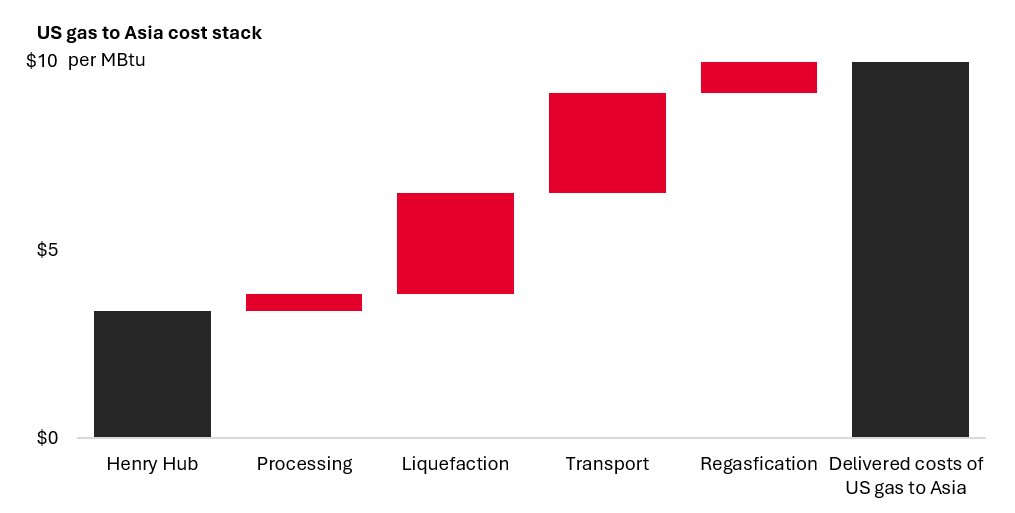
As domestic gas reserves decline in key markets, Shell expects LNG imports to continue to fill the gap. However, on average, LNG is substantially more expensive than pipeline domestic gas due to the additional costs of processing, liquefaction, transportation and regasification (Figure 1). In price-sensitive Asian markets, where Shell expects the largest demand growth, this may be particularly challenging for LNG’s future competitiveness.
Figure 1: LNG is structurally more expensive than natural gas
Source: ACCR analysis of Rystad Energy data and Bloomberg data. Conclusions are ACCR’s.
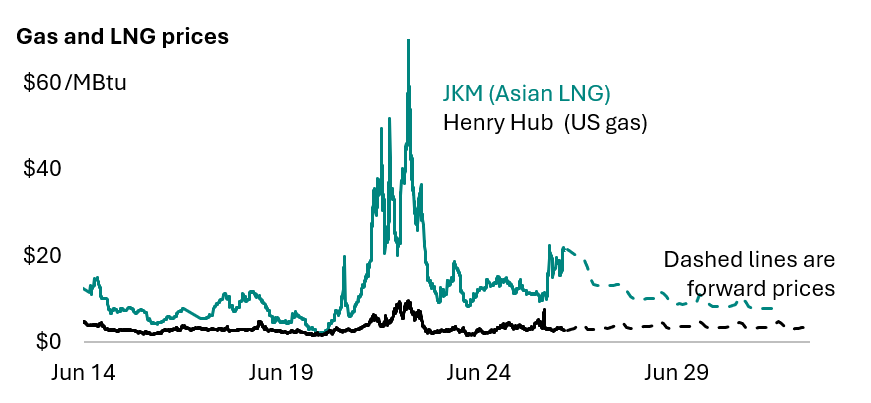
LNG prices have historically been far above domestic gas prices. ACCR analysis finds that JKM LNG prices, the main LNG benchmark in Asia, have averaged around 300% above Henry Hub natural gas prices over the past decade (Figure 2). While additional supply and greater market liquidity may narrow this gap, forward prices continue to imply a substantial premium through the remainder of this decade, with future JKM prices around 250% more expensive than US gas.
Figure 2: LNG is about 300% more expensive than non-liquefied US gas
Source: Bloomberg as at August 4, 2026.
LNG may be too expensive to replace declining domestic gas
Shell treats historic gas demand growth as a proxy for LNG demand growth,[3] assuming declining domestic gas demand will make way for LNG demand growth.[4] However, this assumes LNG remains competitive enough to replace domestic gas as local production declines.
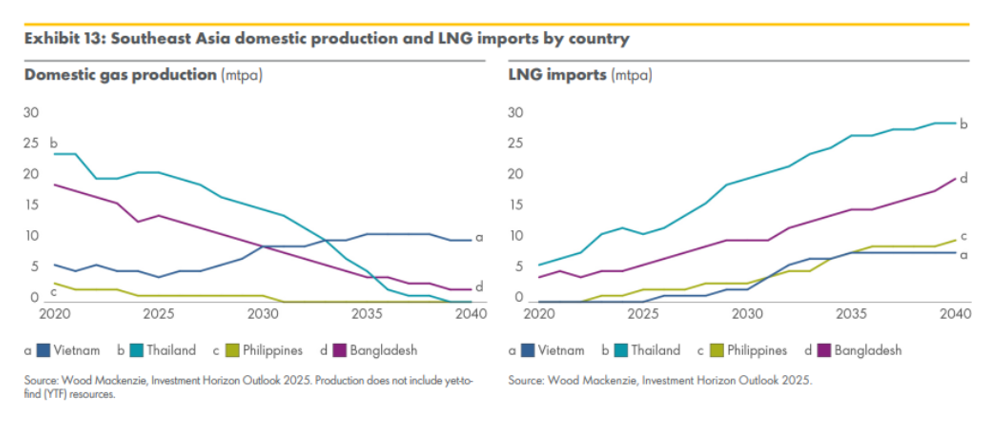
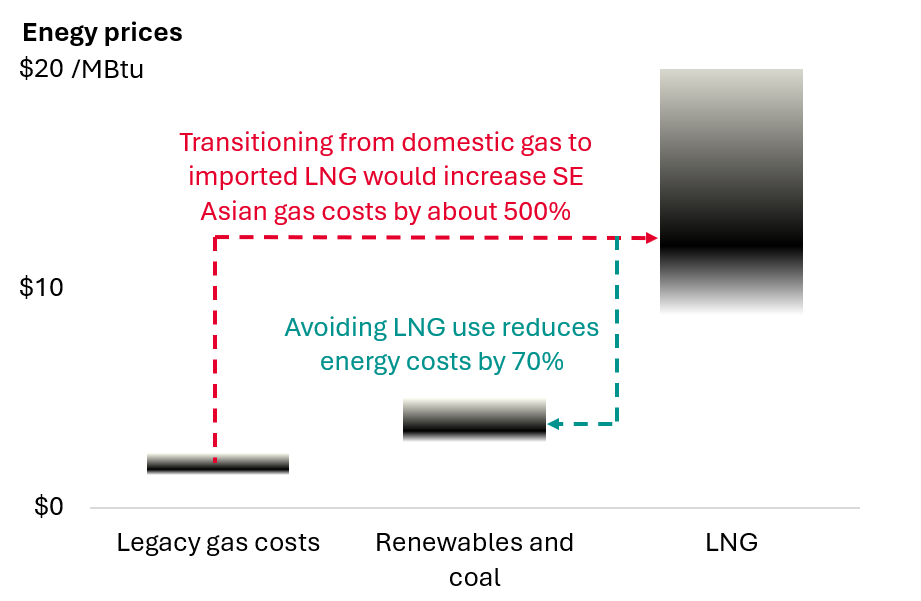
Shell expects Vietnam, the Philippines, Thailand and Bangladesh to import an additional 45 million tonnes per annum of LNG by 2040, driven primarily by declining domestic gas production (Figure 3). But ACCR analysis of energy costs in these countries suggests a switch from domestically produced gas to imported LNG would increase costs by around 500% – existing domestic gas production in these countries costs around $2/MBtu, while LNG costs around $12.5/MBtu based on forward prices through to 2030 (Figure 4). Instead, the data suggests that switching to renewables or coal would reduce costs by around 70% relative to LNG based on current forward prices (Figure 4).
Figure 3: Shell expects LNG will be chosen to replace domestic gas production in Southeast Asia
Source: Shell, LNG Portfolio: Strategic Spotlight, Exhibit 13, p. 8.
Figure 4: LNG is about 500% more expensive than legacy domestic gas in Vietnam, Thailand, Bangladesh and the Philippines[5]
Source: ACCR analysis of IEA and Rystad Energy data. Conclusions are ACCR’s.
Shell assumes LNG use across power generation, industry, heating and transport will drive LNG growth.[6] However, these sectors are increasingly being electrified, with lower-cost technologies reducing the potential role available to LNG. Since 2015, global electricity use grew twice as fast as total energy consumption and is expected to grow around four times faster through to 2035.[7]
Industry
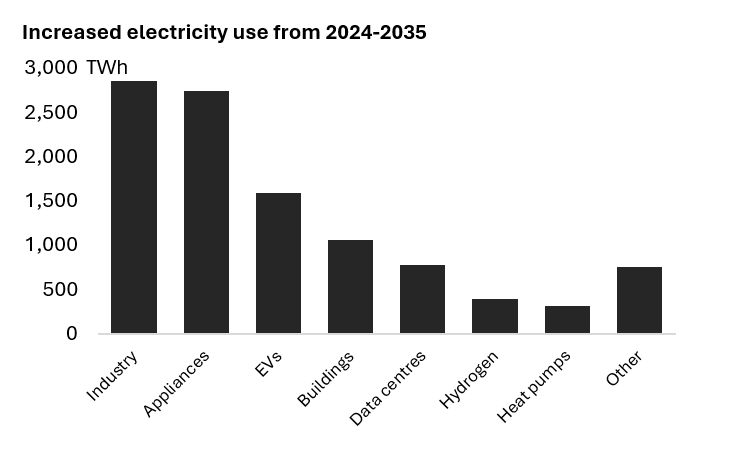
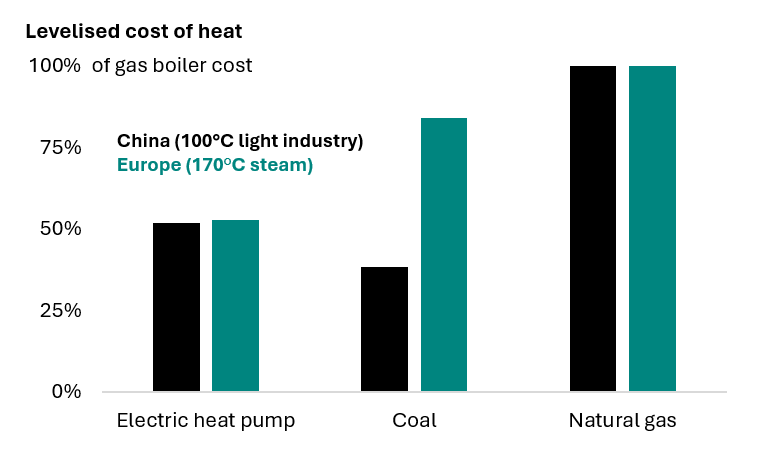
Shell identifies industry as the largest source of future gas demand growth and suggests efforts to reduce emissions and improve air quality are driving industrial coal-to-gas switching.[8] Yet a growing share of future industrial demand can be met through electricity, not gas. Industry is expected to be the largest source of electricity demand growth over the next decade (Figure 5). Electric heat pumps are already cost-competitive for many low-temperature industrial processes up to 170°C (Figure 6).
The range of industrial heat that can be electrified continues to expand. Electric boilers, heat pumps and other technologies established in industry can now supply heat up to 400°C.[9] Commercially available technologies like these can provide most heat for industrial subsectors such as food and beverages, textiles and paper.[10] As renewable electricity becomes cheaper, an increasing share of industrial energy demand may be met by electricity rather than LNG.
Figure 5: IEA – Industrial electrification is the largest driver of electricity growth
Source: ACCR adaption of Figure 4.19 in IEA, WEO 2025, p. 194.
Figure 6: Electric heat pumps are now cost-competitive for low-grade heat
Source: ACCR analysis of IEA[11] and Hasanbeigi[12] data.
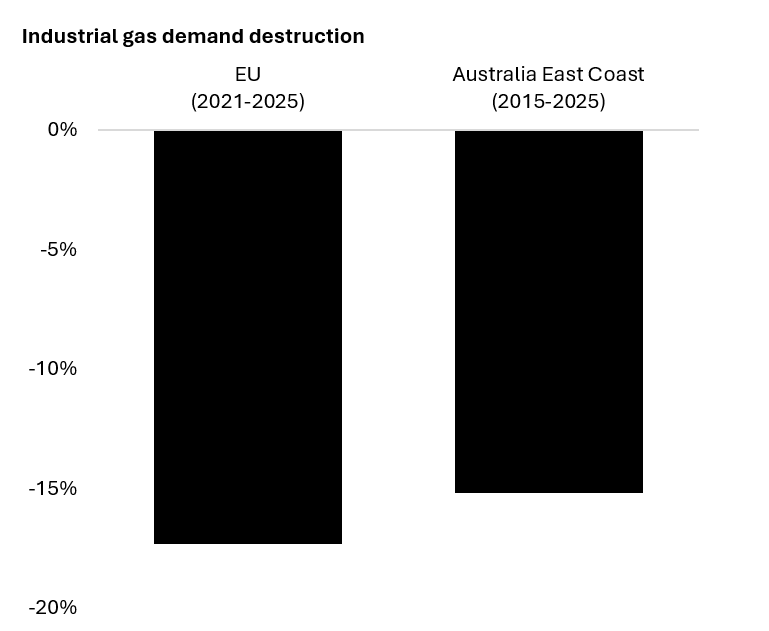
The availability of lower-cost alternatives matters because industrial users may reduce gas consumption rather than absorb the higher costs associated with LNG. Industrial gas consumption fell in Europe between 2021 and 2025 as Russian pipeline supplies were increasingly replaced by LNG imports, and on Australia's east coast between 2015 and 2025 after LNG exports increased exposure to international gas prices (Figure 7). As electrification becomes increasingly competitive, industrial consumers exposed to high LNG prices will have greater scope to reduce their reliance on gas.
Figure 7: Industrial gas consumption has decreased when shifting from gas to LNG prices
Source: ACCR analysis of AEMO and IEA data.
Transport
Road transport is not a material source of LNG demand and is likely to face increasing competition from electrification, particularly Chinese producers. As electric vehicle costs fall and charging infrastructure expands, electrification may capture a growing share of freight demand that Shell expects LNG to serve.
In China, LNG truck sales peaked in March 2024 and were overtaken by battery-electric truck sales in May 2025.[13] In December 2025, battery-electric vehicles accounted for more than half of monthly truck sales.[14]
Shell’s forecast for LNG growth in heavy-duty road transport also does not look beyond 2030.[15] This matters as cost of ownership analysis suggests that electric trucks will become cheaper than LNG-powered freight vehicles on average throughout the 2030s across China, Germany and the US (Figure 8).
Figure 8: Gas is too expensive to play a major role in road transport, even for long-haul freight
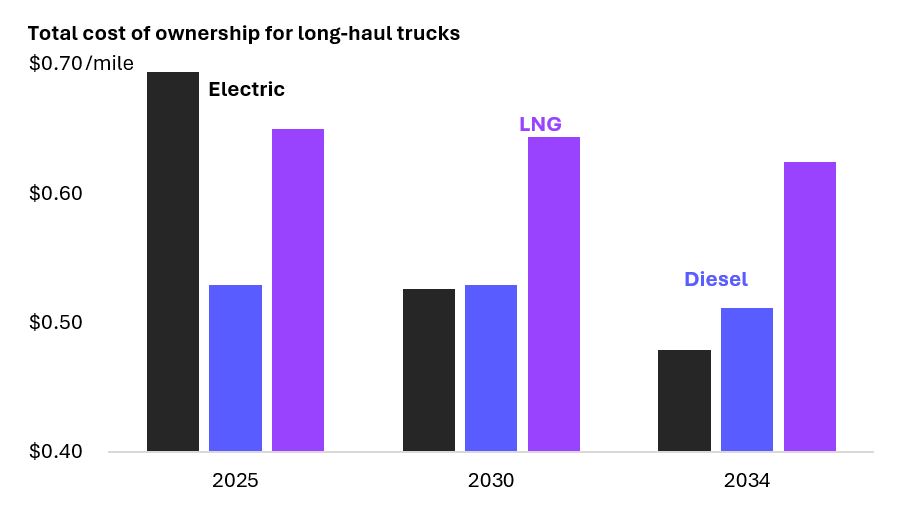
Source: ACCR analysis of BNEF Total Cost of Ownership (TCO) tool. Average of Chinese, US and German TCO for medium-duty commercial vehicles in long-haul freight.
In electricity markets, falling costs for renewables and storage are making LNG-fired generation and LNG-based firming increasingly uncompetitive. Firmed solar and wind are now cheaper than LNG-fired generation (Figure 9) - eight years ago, the reverse was true. Today, LNG generation costs over $100/MWh, and is about 30% more expensive than firmed PV (Figure 9).
Figure 9: Firmed solar and wind is cheaper than LNG generated power
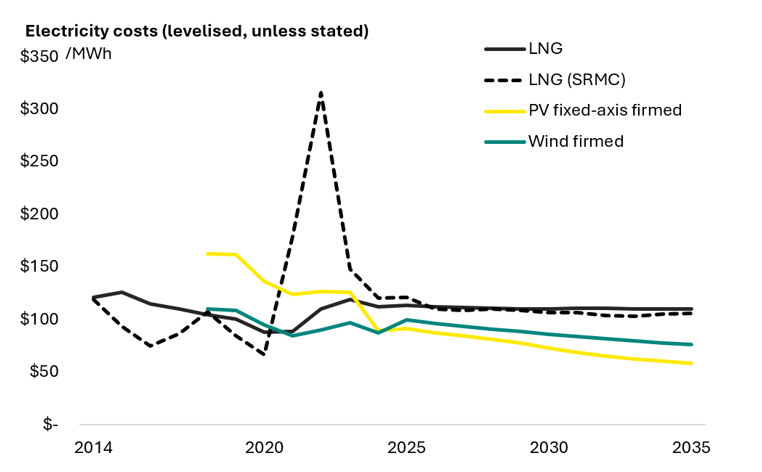
Source: ACCR analysis of Bloomberg data based on the simple average of costs for European and Asian gas-importing nations.
The economics of system balancing are also shifting. Shell argues that LNG can support increasing renewable penetration by providing flexible generation when wind and solar output varies. However, grid-scale batteries are becoming a significantly cheaper source of flexibility. Battery-based firming is now around 60% cheaper than LNG-fuelled open-cycle gas turbines on a levelised cost basis (Figure 10). While batteries cannot provide all grid firming services, declining battery costs and increased battery duration are increasing competition for one of the key roles that Shell expects LNG to play in future electricity systems.
Figure 10: Firming renewables with batteries is 60% cheaper than using LNG
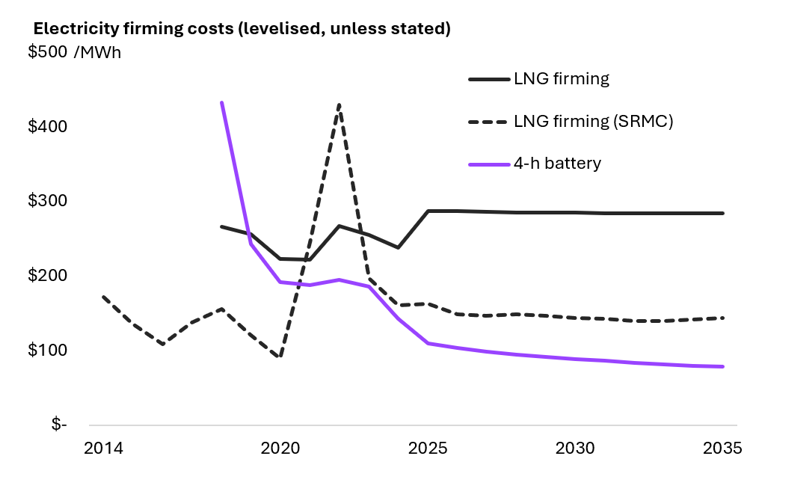
Source: ACCR analysis of Bloomberg data based on simple average of costs for European and Asian gas-importing nations. “LNG firming” is based on open cycle gas turbine data.
Download a PDF of Part 2: LNG is increasingly uncompetitive
Shell plc, LNG Portfolio: Strategic Spotlight, March 2026, p. 5, https://www.shell.com/investors/investor-presentations/_jcr_content/root/main/section_1529014047_c_540020954/tabs/tab_1774293805/text_copy_copy_16298_313993862/links/item0.stream/1773644841391/3328e7b37c74c7757cb1c3756fb96ad299de4988/lng-portfolio-strategic-spotlight-2026.pdf. ↩︎
Stapczynski, Stephen, et al., “Pakistan Faces Further Blackouts After Rejecting Pricey LNG,” Bloomberg, September 2, 2026, https://www.bloomberg.com/news/articles/2026-09-02/pakistan-faces-further-blackouts-after-rejecting-pricey-lng. ↩︎
Shell plc, LNG Portfolio: Strategic Spotlight, March 2026, Exhibits 1 (p. 3), 9 (p. 6), 10 (p. 6) and 14 (p.8), https://www.shell.com/investors/investor-presentations/_jcr_content/root/main/section_1529014047_c_540020954/tabs/tab_1774293805/text_copy_copy_16298_313993862/links/item0.stream/1773644841391/3328e7b37c74c7757cb1c3756fb96ad299de4988/lng-portfolio-strategic-spotlight-2026.pdf. ↩︎
Ibid, p. 8. ↩︎
“Legacy gas costs” refers to the average FID breakeven prices of currently producing assets in the Philippines, Thailand, Bangladesh and Vietnam. “Renewables and coal” refers to the LNG price required to compete with these energy sources, as per IEA, WEO 2024, p. 19. “LNG” refers to Bloomberg JKM daily forward prices through the rest of the 2020s as at August 4, 2026. Conclusions are ACCR’s. ↩︎
Shell plc, LNG Portfolio: Strategic Spotlight, March 2026, p. 6, https://www.shell.com/investors/investor-presentations/_jcr_content/root/main/section_1529014047_c_540020954/tabs/tab_1774293805/text_copy_copy_16298_313993862/links/item0.stream/1773644841391/3328e7b37c74c7757cb1c3756fb96ad299de4988/lng-portfolio-strategic-spotlight-2026.pdf. ↩︎
IEA, 2025 World Energy Outlook, November 2025, p. 193, https://www.iea.org/reports/world-energy-outlook-2025. ↩︎
Shell plc, LNG Portfolio: Strategic Spotlight, March 2026, p. 6, https://www.shell.com/investors/investor-presentations/_jcr_content/root/main/section_1529014047_c_540020954/tabs/tab_1774293805/text_copy_copy_16298_313993862/links/item0.stream/1773644841391/3328e7b37c74c7757cb1c3756fb96ad299de4988/lng-portfolio-strategic-spotlight-2026.pdf. ↩︎
Madeddu, Silvia, et al., “The CO2 reduction potential for the European industry via direct electrification of heat supply (power-to-heat),” Environmental Research Letters 15, no. 12 (2020), p. 5, https://www.doi.org/10.1088/1748-9326/abbd02. ↩︎
IEA, Renewables for Industry: Electrification of low-temperature heat and steam, February 2026, p. 3, https://iea.blob.core.windows.net/assets/7629a238-e862-47c9-b2d4-2cbd408ad171/RenewablesforIndustryElectrificationoflow-temperatureheatandsteam.pdf. ↩︎
IEA, The Future of Heat Pumps in China, August 2024. Fig 3.13 (p. 101), https://iea.blob.core.windows.net/assets/c099bae3-40f1-48cf-b905-64ff37755867/FutureofHeatpumpsinChina.pdf. 2022 data. ↩︎
Hasanbeigi, Ali, et al., Region Summary: Electrification of Industry in the EU27, October 2024, Global Efficiency Intelligence, Figure 5 (p. 5), https://static1.squarespace.com/static/5877e86f9de4bb8bce72105c/t/6719f9fd3975d320de46dd8b/1729755656761/EU27%2BSummary.pdf. ↩︎
Doleman, Christopher, “Surging electric truck sales stall China's LNG trucking boom,” Institute for Energy Economics and Financial Analysis, August 4, 2025, https://ieefa.org/resources/surging-electric-truck-sales-stall-chinas-lng-trucking-boom-0. ↩︎
Zhang, Phate, “Demand frontloading propels China's new energy heavy-duty truck penetration past 50% for 1st time,” CnEVPost, January 22, 2026, https://cnevpost.com/2026/01/22/china-new-energy-heavy-duty-truck-penetration-50-1st-time/. ↩︎
Shell plc, LNG Portfolio: Strategic Spotlight, March 2026, p. 7, https://www.shell.com/investors/investor-presentations/_jcr_content/root/main/section_1529014047_c_540020954/tabs/tab_1774293805/text_copy_copy_16298_313993862/links/item0.stream/1773644841391/3328e7b37c74c7757cb1c3756fb96ad299de4988/lng-portfolio-strategic-spotlight-2026.pdf. ↩︎