28th October 2026
This communication is for informational purposes only and does not constitute financial, legal, or professional advice. ACCR does not hold an Australian Financial Services Licence and does not provide financial product advice. The purpose of this communication is not to provide financial product advice. Please read the terms and conditions attached to the use of this site.
This is an excerpt from our October newsletter. Subscribe to receive our latest research, insights and updates directly to your inbox.
Post-2030 targets, overshoot risk and who absorbs uninsured climate losses.
Over the past six weeks, conversations with investors about our BHP research and 2026 Annual Report review have repeatedly returned to the same question: what drives decarbonisation decision-making beyond 2030?
Since the launch of the Science Based Targets initiative in 2015, many major companies have set 2030 interim targets alongside their 2050 net zero commitments. But as 2030 shifts from a medium- to near-term milestone, few have established new medium-term targets, leaving a two-decade governance gap between near-term commitments and long-term ambitions.
Without a 2040 target, investors have limited visibility into whether a company’s decisions are consistent with its 2050 net zero goal. This makes it harder to assess progress, scrutinise capital allocation and hold management accountable for decisions that preserve or erode future decarbonisation options
BHP illustrates the problem. The company has effectively achieved its relatively modest 2030 operational emissions reduction target but has no target between 2030 and 2050. Yet many of the investments that will determine its emissions through the 2030s are being considered now, including those needed to address diesel and fugitive methane emissions. Haul trucks are one example: those purchased today could be partially or fully electrified later or could lock in diesel use for their operating life.
Decisions made today will shape emissions trajectories well into the 2030s and beyond. A 2040 target would provide a critical milestone against which to assess those decisions, strengthen accountability and ensure near-term investments remain consistent with long-term decarbonisation goals. Investors engaging with BHP, Rio Tinto and other major miners should make 2040 targets a core ask, alongside greater scrutiny of capital allocation decisions that could lock in emissions through the 2030s.
Science-based stewardship
The 2030s will be crucial for limiting overshoot
In September, UNEP’s Limiting Overshoot report warned that 1.5°C of warming is now unavoidable. Global average temperatures are pushing above 1.4°C and are expected to pass 1.5°C around 2030.
For companies, the report is a timely reminder that their contribution to future warming depends on the shape of their emissions pathway to net zero. Consider two companies that both reach net zero in 2050: the first reduces its emissions early, meeting 2030 and 2040 interim targets; the second delays reductions until the 2040s. While both companies achieve net zero by 2050, the second will have released considerably more CO₂ along the way. This is important because the climate responds to cumulative CO₂ emissions – the total released over time, or the area under an emissions curve. The report stresses this risk of delay – rapid emissions reductions can limit the extent and duration of overshoot above 1.5°C. “Every fraction of a degree avoided reduces risks. Every year by which overshoot duration is shortened reduces exposure. Every investment in resilience preserves future options,” it states.
In 2026, climate shocks like the European heatwaves and a glacier collapse in Nepal have highlighted how 1.4°C of warming is already testing the resilience of economies and their capacity to adapt. Climate science, however, indicates that warming above 1.5°C pushes Earth into a significantly more dangerous state.
Every fraction of a degree past 1.5°C increases the risk of triggering tipping points, while warming beyond 2.0°C “strongly accelerates” tipping risks. Tipping points include the loss of major ice sheets, the breakdown of critical ocean currents and the collapse of coral reefs, and are expected to cause abrupt, dangerous and potentially irreversible impacts.
Current policies are expected to push temperatures to 2.6°C by 2100. However, a safer, more secure climate is possible. According to the UN report, faster and deeper emissions cuts could limit warming to 1.8°C.
Investors can help shape the future warming pathway. The 2030s will be a crucial decade for testing whether companies are on track for net zero by 2050. This makes interim targets for 2040 a critical accountability tool.
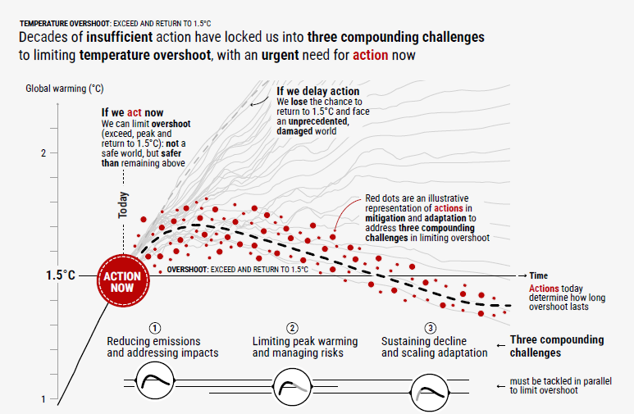
Faster and deeper cuts to emissions can limit the extent and duration of warming above 1.5°C. Source: UNEP.
Question of the Quarter - As climate extremes intensify, who will absorb the losses?
Climate-related losses are mounting. Insured losses from natural catastrophes, primarily climate events, are increasing by 5-7% each year. Yet, there is growing uncertainty over who ultimately bears the losses when insurance becomes unaffordable or unavailable.
The Australian Prudential Regulation Authority’s (APRA) latest Insurance Climate Vulnerability Assessment highlights the potential scale of this issue. The report stress tests Australia’s home insurance gap over the coming decades. It found that the proportion of Australian households without home insurance protection could rise from one in seven today to one in four by 2050 with 1.8°C of warming.
The erosion of insurance protection can have economy-wide impacts that reverberate through property markets, credit systems and public finances. In Ortec Finance’s 2026 climate scenarios, its 2.8°C ‘Limited Action’ pathway shows that by 2050 around 30% of the US population could live in states facing insurability stress, where the median cost of home insurance exceeds one month’s household income. Ortec’s modelling shows how declining affordability and coverage can constrain mortgage availability and depress home values, while shifting a growing share of climate losses onto governments – with material implications for public finances, sovereign debt and financial stability.
In California, for example, the state-created FAIR Plan, an insurer of last resort, is covering an increasing number of properties due to the withdrawal of major insurers. In one region of California prone to wildfires, the scheme is the only option for one in ten homes. As of June 2026, the FAIR Plan covered nearly 700,000 residential and commercial properties, with total risk exposure of $788 billion.
Beyond insurance, there are signs climate risk is beginning to register in financial markets. JPMorgan's Sarah Kapnick recently described a shift in the way fixed-income investors consider physical climate risk. She says they are paying far greater attention to physical climate risks compared to just five years ago and are increasingly reflecting those risks in pricing.
But in our view recognising individual exposures is only part of the challenge when it comes to assessing future physical risk exposure. Are investors adequately considering the wider transmission channels through which uninsured losses can undermine property values, credit markets and sovereign finances – and ultimately affect entire portfolios?